Places: Warmingham


Widget not in any sidebars

Place Type

Parish

County

Cheshire

Parish

Warmingham

Deanery

Middlewich

Causes

EDC 5/1/6 – John Minshull and Sir Gilbert Lightfoot, chaplain, contra Alice Scariot


WARMINGHAM 

This small parish was a rectory which comprised the townships of Warmingham, Tetton, Elton and Moston.

The advowson belonged to the owner of the manor of Warmingham which passed to the earls of Oxford at the end of the fifteenth century and was then sold to Sir Christopher Hatton in 1580. The gravestone of Henry Wegley (or Wigley), the rector instituted to the parish in 1654 and died in 1680 may still be seen set into a path around the church.

The medieval timber-framed parish church, of which nothing now survives, was rebuilt in brick and stone in 1715. The chancel and body of the church were rebuilt in 1797 and in 1870 the chancel, nave and transept were again reconstructed, leaving only the tower surviving from 1715, although that has some later alterations.

The sandstone base of a medieval cross still stands in the churchyard, topped by a later column which held a sundial at one time. A late sixteenth-century farmhouse, with later alterations and extensions, may still be seen opposite the church.

A single arch sandstone bridge, dating from about 1750, carries the road between Crewe and Middlewich past the church over the River Wheelock.

The area of the parish is still predominantly agricultural.

Sources

George Ormerod, The History of the County Palatine and City of Chester (second edition, revised and enlarged by T. Helsby, London, 1882), vol. iii, pp. 225-235


Click to view fullscreen

Places: Wigan


Widget not in any sidebars

Place Type

Parish

County

Lancashire

Parish

Wigan

Deanery

Warrington

Causes

EDC 5/1/5 – Anne Orell contra Piers Orrell


WIGAN 

The parish of Wigan comprised the townships of Wigan, Pemberton, Billinge Chapel End, Billinge Higher End, Winstanley, Orrell, Upholland, Dalton, Ince, Hindley, Abram, Haigh and Aspull.

In 1563 it was one of the most populous parishes in the county of Lancashire with 808 households, although converting number of households to size of population is notoriously problematic.

The parish was home to Upholland Priory which was a poor foundation with a rather dubious reputation. It was dissolved in 1536 with the poorer monasteries as its annual income was below £100.

It is understood that there was a church in Wigan before the Norman Conquest, but the oldest parts of the present building date from the thirteenth century. These include the lower part of the tower and most of the roof of the nave.

The building was subsequently reconstructed at various times. In 1620 extensive rebuilding of the chancel, nave and chantry chapels was carried out, but much of this work was demolished and rebuilt in the mid-nineteenth century and none of the medieval fittings remain.

Ownership of the advowson was disputed for several centuries but by 1446 it was settled with the Langton family. However, by the sixteenth century they often sold the right of next presentation and by the end of the century the family had sold their rights in the parish entirely.

In the sixteenth century the tithes, or parts of them, were generally farmed out, so that the rectors did not receive all the income from the parish but even so it was a relatively wealthy living and in the first part of the sixteenth century it was held for brief periods by a succession of absentee pluralists who left the running of the parish to curates. These pluralist rectors included Thomas Stanley, bishop of Sodor and Man, a relative of the earls of Derby. He also held two other parishes as well as the bishopric.

In 1571 Edward Fleetwood was appointed to the parish by the Queen and held the living until his death in 1604. He was a religious radical and keen preacher who was very hostile to Catholics. However, he, too, was not always resident in his parish and allowed the chancel of the church to fall into disrepair. He also failed to provide curates for all the chapels of the parish.

Unusually, the rectors were effectively lords of the manor of Wigan with quite extensive secular legal authority.

In common with many areas of south Lancashire, coal mining and the textile industry flourished with other industry in the parish from the late eighteenth century and agriculture became less important. Wigan is now part of the Greater Manchester conurbation.

Sources:

George T. O. Bridgeman, The history of the church and manor of Wigan in the County of Lancaster, Part 1, Chetham Society, new series, 15 (1888)

Alan Dyer and D. M. Palliser (eds), The Diocesan Population Returns for 1563 and 1603 (Oxford, 2005), pp. xli, 84

Christopher Haigh, Reformation and Resistance in Tudor Lancashire (Cambridge, 1975), pp. 305-306

Mike Salter, The Old Parish Churches of Lancashire (Malvern, 2005), p. 84

‘Houses of Benedictine monks: The priory of Upholland’, in A History of the County of Lancaster: Volume 2, ed. William Farrer, J Brownbill( London, 1908), British History Online https://www.british-history.ac.uk/vch/lancs/vol2/pp111-112

‘The parish of Wigan: Introduction, church and charities’, in A History of the County of Lancaster: Volume 4, ed. William Farrer, J Brownbill( London, 1911), British History Online https://www.british-history.ac.uk/vch/lancs/vol4/pp57-68


Places: Accrington


Widget not in any sidebars

Place Type

Township

County

Lancashire

Parish

Whalley

Deanery

Blackburn

Causes

EDC 5/1580/10 – Anne Jackson contra Anne Jones, wife of Thomas Jones

ACCRINGTON

Accrington, in the parish of Whalley, comprised two townships – Old Accrington and New Accrington – which were united in 1878.

The agricultural land of the area is mainly pasture. By 1830 textile industries were developing in the town, notably calico weaving and printing and cotton spinning. Associated works producing textile machinery also grew up. From the fifteenth century there were collieries, quarries and mines in the area. The town was also famous for the manufacture of bricks.

There was a chapel at Accrington which was confiscated as a chantry in about 1547, but subsequently restored in 1553 on payment of a fee. The vicars of Whalley were responsible for maintaining worship there, and the chapel did not usually have its own minister. The chapel was demolished and rebuilt in 1826.

Sources:

‘Townships: Old and New Accrington’, in A History of the County of Lancaster: Volume 6, ed. William Farrer, J Brownbill( London, 1911), British History Online https://www.british-history.ac.uk/vch/lancs/vol6/pp423-427

‘Abingdon – Ackton’, in A Topographical Dictionary of England, ed. Samuel Lewis( London, 1848), British History Online https://www.british-history.ac.uk/topographical-dict/england/pp5-9


Places: Middleton


Widget not in any sidebars

Place Type

Parish

County

Lancashire

Deanery

Manchester

Causes

EDC 5/12/1 – Robert Assheton, rector of Middleton, contra John Aspinall, John Allens and John Bradley.
EDC 5/13/3 – Robert Assheton, rector of Middleton, contra Giles Johnson.
EDC 5/1580/10 – Anne Jackson contra Anne Jones, wife of Thomas Jones.


MIDDLETON

The parish comprised Middleton, Pilsworth, Hopwood, Thornham, Great Lever, Ashworth, Ainsworth and Birtle-cum-Bamford, the last four being detached from the main parish.

The original parish church or chapel was built before 1066 and was dedicated to St Cuthbert, following the Norman Conquest a new church was built and dedicated to St Leonard. However, there is still a side chapel dedicated to St Cuthbert.

The church was entirely rebuilt in the early fifteenth century by Cardinal Thomas Langley, Lord Privy Seal and archdeacon of York, who was a native of Middleton. His building incorporated some remains of earlier building such as the arch between the tower and the nave (thought to be twelfth century).

The church building underwent further reconstruction a century later when Richard Assheton, lord of the manor of Middleton, enlarged it considerably and added the clerestory.

Subsequent rebuilding included the addition to the tower of its unusual wooden cap. The church retains many early features, however, including the rood screen and other early woodwork, together with some stained glass.

The advowson always belonged to the owner of the manor of Middleton which remained in the Assheton family for centuries. Many of the sixteenth-century rectors of the parish were family members.

Coal mines in Thornham and Hopwood helped to fuel the development of the textile industry which flourished with other industry in the parish from the late eighteenth century. Middleton is now part of the Manchester conurbation.

Cardinal Langley founded a church school which moved in 1586 to a new building which still stands on the bank of the River Irk.

Sources

Sir Stephen R. Glynne, Bart., Notes on the churches of Lancashire, ed. James Augustus Atkinson, (Chetham Society, new series, 27, 1893).

‘The parish of Middleton’, in A History of the County of Lancaster: Volume 5, ed. William Farrer, J Brownbill( London, 1911), British History Online https://www.british-history.ac.uk/vch/lancs/vol5/pp151-161 [accessed 7 January 2025]


Click to view fullscreen

Places: Astbury


Widget not in any sidebars

Place Type

Parish

County

Cheshire

Parish

Astbury

Deanery

Middlewich

Causes

EDC 5/1580/9 – Jane Agard contra John Leigh, esquire, of Ridge and Elizabeth Leigh, widow, of Ridge

ASTBURY

The parish of Astbury was on the eastern boundary of Cheshire, bordering Staffordshire, and comprised eleven townships being Buglawton, Congleton, Davenport, Eaton, Great Moreton, Hulme-Walfield, Newbold Astbury, Odrode, Smallwood, Somerford Booths and Somerford cum Radnor.

The church was mentioned in the Domesday Book and following lengthy litigation it was accepted by the end of the fourteenth century that the rectory belonged to St Werburgh’s Abbey in Chester. Following the dissolution of the abbey the advowson passed to the dean and chapter of the new cathedral and from them to Sir Richard Cotton and then to the Egerton family. The rectors owned all the tithes of the parish but tended to be absentee pluralists, at least in the early part of the sixteenth century. Thus John Brereton, brother of the executed courtier, William, held the parish from 1535 until his death 1542. At the same time, he was a royal chaplain and held the parishes of St Mary in Chester, Christleton and both moieties of Malpas in Cheshire, as well as being a canon of St Paul’s. He was succeeded in the parish by Hugh Powell (or ap Howell/Apowell) who also held the parish of Eccleston in Cheshire and Llanvetherine in Monmouthshire.

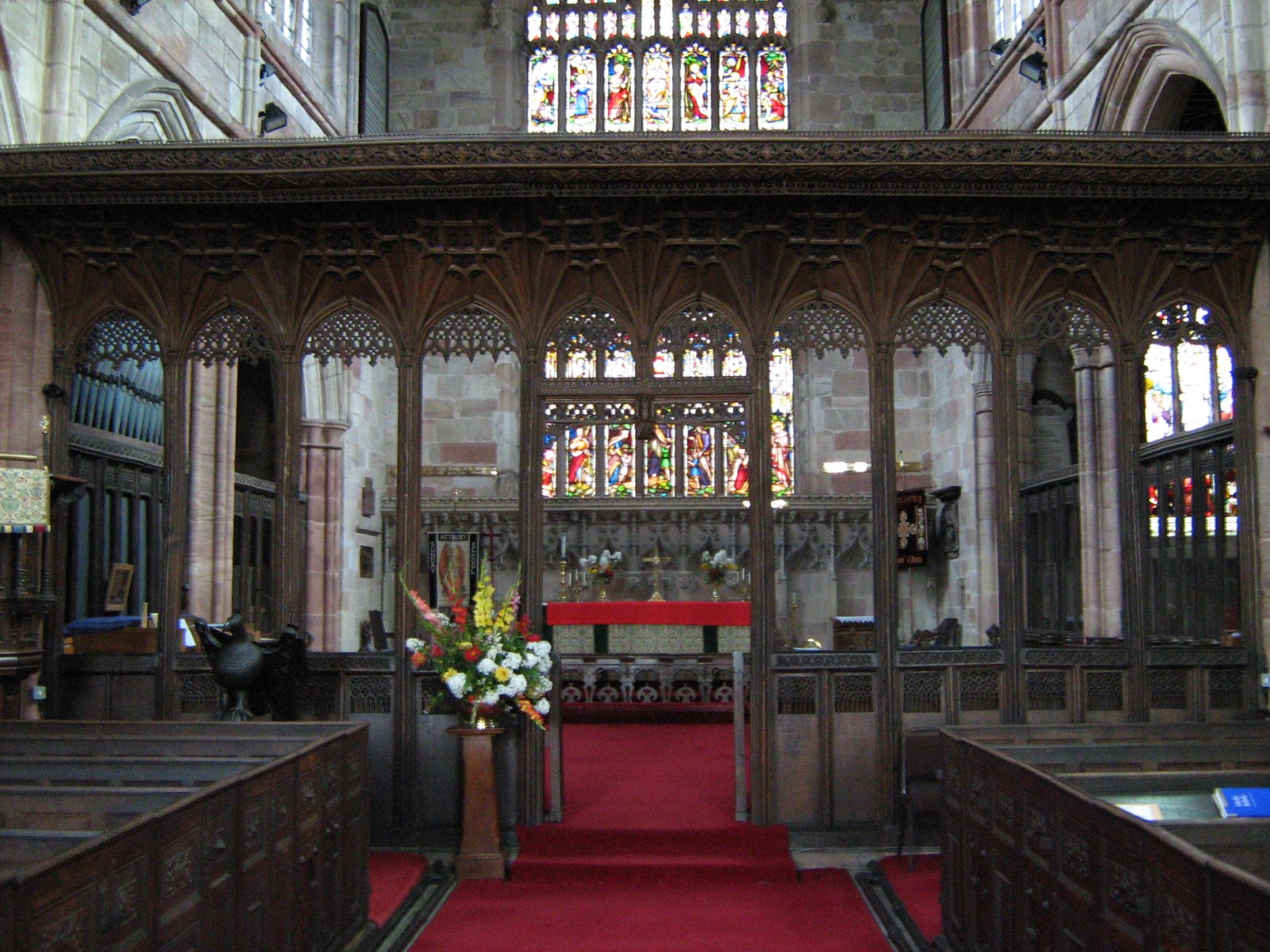
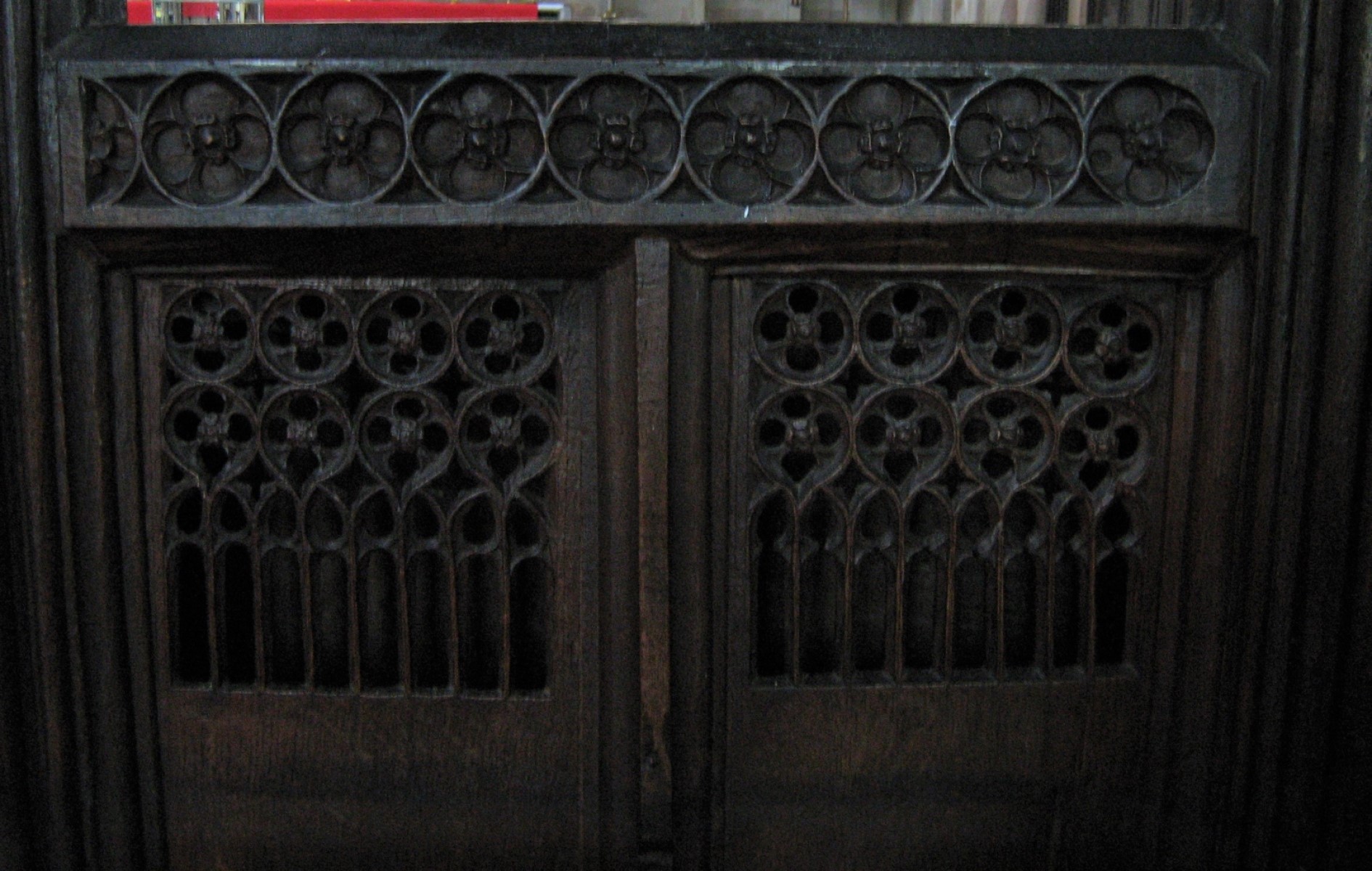
The existing church was originally built in the twelfth century but substantially altered over the next three hundred years. The church building is unusual in that the tower, probably dating from the fourteenth century, is not integrated into the main building, but connected to it by a passage. Much of the woodwork of the interior, including the chancel screen and the parclose screen (separating the aisle from the nave), dates from about 1500, and it is thought that a surviving wall painting of St George dates from about the same time.

The fourteenth-century tomb of Ralph Davenport can be seen in the church, in the churchyard is a medieval canopied tomb, but the figures of a knight and his lady associated with it have been badly weathered.

Sources:

Rev. J. E. G. Cartlidge, Newbold Astbury and its History (Congleton, 1915: reprinted 2004)

J. P. Earwaker, The History of the Church and Parish of St Mary-on-the-Hill Chester (London, 1898), p. 80

Miriam Gill, ‘ “Now help, St George, oure lady knyght … to strengthe our Kyng and England ryght”. Rare scenes of Saint George in a wall painting at Astbury, Cheshire’, Transactions of the Lancashire and Cheshire Antiquarian Society, 91 (1997) pp. 91-102.

Douglas Jones, The Church in Chester 1300-1540 (Chetham Society 3rd series, 7, 1957), p. 176

George Ormerod, The History of the County Palatine and City of Chester (second edition, revised and enlarged by T. Helsby, London, 1882), vol. iii, pp. 21-72

The black and white images are reproduced from volumes 64, 68 and 69 of the Transactions of the Historic Society of Lancashire and Cheshire by kind permission of The Historic Society of Lancashire and Cheshire.

Click to view fullscreen

Places: Churton


Widget not in any sidebars

Place Type

Township

County

Cheshire

Parish

Aldford and Farndon

Deanery

Malpas and Chester

Causes

EDC 5/1580/8 – Alice Haselwall, wife of Christopher Haselwall, contra Ellen Barrowe

CHURTON

The township of Churton lay partly in the parish of Aldford and partly  in the parish of Farndon. This split resulted from the division of the township between the manors of Aldford and Farndon.

Source

George Ormerod, The History of the County Palatine and City of Chester (second edition, revised and enlarged by T. Helsby, London, 1882), vol. ii, pp. 745-746

Places: Aldford


Widget not in any sidebars

Place Type

Parish

County

Cheshire

Parish

Aldford

Deanery

Malpas

Causes

EDC 5/1580/8 – Alice Haselwall, wife of Christopher Haselwall, contra Ellen Barrowe

ALDFORD

The parish is not far from Chester and comprised the townships of Aldford, Buerton, Edgerley and half of Churton. Aldford itself is situated on the River Dee.

The remains of a motte and bailey castle, said to date from the twelfth-century, can still be seen near to the church.

The advowson of the rectory was owned by the lords of the manor. The Stanleys of Alderley held the manor in the early years of the sixteenth century. It subsequently passed back to the Crown and was purchased by the courtier, William Brereton, but was forfeit following his execution. It was later sold to Sir Edward Fitton of Gawsworth and Robert Tatton jointly but was eventually purchased by the Grosvenors of Eaton who funded the rebuilding of the church and much of the village of Aldford.

The radical Protestant, Christopher Goodman, who had been joint leader with John Knox, of the exile congregation in Geneva during the reign of the Catholic Mary Tudor, was appointed rector of Aldford in 1567. Goodman’s Puritan practices, such as the use of bread instead of wafers at communion, seems to have been popular in the parish as ‘a great assembly’ gathered for his service on Palm Sunday in 1570, but he was not popular with either the Queen or the church authorities and was obliged to resign the living in 1572. He was replaced by another religious radical, John Lane.

The church building was in a poor state of repair by the early nineteenth century and was demolished and rebuilt to a design by John Douglas; the new building being consecrated in 1866.

The churchyard cross was erected in 1901 but stands on a plinth which is probably medieval. The sundial in the churchyard probably dates from the eighteenth century. The stocks, currently undergoing restoration, are thought to date from the seventeenth century.

Sources:

Denbigh Record Office, DD/PP/839 ff.111-113

George Ormerod, The History of the County Palatine and City of Chester (second edition, revised and enlarged by T. Helsby, London, 1882), vol. ii, pp. 754-760

Jane E. A. Dawson, ‘Goodman, Christopher (1521/2-1603)’,Oxford Dictionary of National Biography (online edition) https://doi.org/10.1093/ref:odnb/10975

Historic England:
Church of St John the Baptist (1135984)
https://historicengland.org.uk/listing/the-list/list-entry/1135984  National Heritage List for England
Cross and Stepped Base East of Path to South Porch of Church of St John the Baptist (1135991)
https://historicengland.org.uk/listing/the-list/list-entry/1135991 National Heritage List for England
Sundial and Pier West of South Porch of Church of St John the Baptist (1129950)
https://historicengland.org.uk/listing/the-list/list-entry/1129950 National Heritage List for England
Stocks, almost Opposite the Grosvenor Arms Inn (1129944)
https://historicengland.org.uk/listing/the-list/list-entry/1129944 National Heritage List for England

Click to view fullscreen

Places: Chester, St Bridget


Widget not in any sidebars

Place Type

Parish

County

Cheshire

Parish

Chester, St Bridget

Deanery

Chester

Causes

EDC 5/1580/7 – Alice Bostocke contra Roger Chauntrell

CHESTER, St BRIDGET

This was one of the smallest and poorest of Chester’s nine medieval parishes. Most of the parish lay on the southern side of the town, within the walls, apart from one detached area south of the river Dee.

The church was appropriated by the College of St John’s by the fifteenth century. Following the dissolution of the college responsibility for the appointment of a curate seems to have passed, at least for a time, to the new cathedral chapter and by the early seventeenth century the living was a rectory in the gift of the bishop of Chester. The parish united with St Martin’s in 1842

The earliest church building was constructed over the site of a Roman gate tower, and this small building remained in use until a new church was constructed in the late seventeenth century. This became unsafe and was taken down in the early nineteenth century. A new church building was constructed opposite the entrance to the castle and opened in 1829, but was in turn demolished in 1892 and the site is now underneath a roundabout.

There was no residence for the incumbent from the time of the demolition of the first church building until 1857, when, following his death, the house designed by the architect Thomas Harrison for himself was given by his daughter to the joint parish of St Bridget and St Martin for the use of the rector. The building is now used as a restaurant.

Sources

N. J. Alldridge, ‘Aspects of the Topography of Early Medieval Chester’, Journal of the Chester Archaeological Society, 64, pp. 17-21.

Douglas Jones, The Church in Chester 1300-1540 (Chetham Society 3rd series, 7, 1957), pp. 7, 109.

J S Barrow, J D Herson, A H Lawes, P J Riden and M V J Seaborne, ‘Churches and religious bodies: Medieval parish churches’, in A History of the County of Chester: Volume 5 Part 2, the City of Chester: Culture, Buildings, Institutions, ed. A T Thacker and C P Lewis (London, 2005), pp. 133-156. British History Online http://www.british-history.ac.uk/vch/ches/vol5/pt2/pp133-156 [accessed 17 February 2023]


Places: Thelwall


Widget not in any sidebars

Place Type

Chapelry

County

Cheshire

Parish

Runcorn

Deanery

Frodsham

Causes

EDC 5/1580/5 – James Banester contra Ellen Urmeston

THELWALL

Thelwall was a chapelry in the parish of Runcorn. It may have been a domestic chapel built for the inhabitants of Thelwall Hall and the surrounding area.


Places: Wincle


Widget not in any sidebars

Place Type

Township

County

Cheshire

Parish

Prestbury

Deanery

Macclesfield

Causes

EDC 5/1566/6 – John Legh, esquire, farmer of the tithes of the hamlets of Sutton and Wincle contra William Sutton and Ralph Gardner

WINCLE

The township of Wincle in Prestbury parish was situated on the River Dane on the border with Staffordshire.

A grange, or farm with outbuildings including a tithebarn, was constructed there on land granted to the abbey of Combermere and was held by the monastery until its dissolution in 1538. This is Wincle Grange, which was sold, with other property belonging to Combermere, to George Cotton following the dissolution of the abbey. It subsequently passed to the Leghs of Ridge.

There were other estates in the township, including Barleyford and White Lee.

The right to receive the great tithes of Wincle was the subject of a dispute in the consistory court in 1566.

Sources

A P Baggs, Ann J Kettle, S J Lander, A T Thacker, David Wardle, ‘Houses of Cistercian monks: The abbey of Combermere’, in A History of the County of Chester: Volume 3, ed. C R Elrington, B E Harris( London, 1980), British History Online https://www.british-history.ac.uk/vch/ches/vol3/pp150-156 [accessed 31 December 2024]

J. P. Earwaker, East Cheshire Past and Present, vol. 2 (London, 1880), pp. 432-437 (images from this volume courtesy of HathiTrust).

Click to view fullscreen