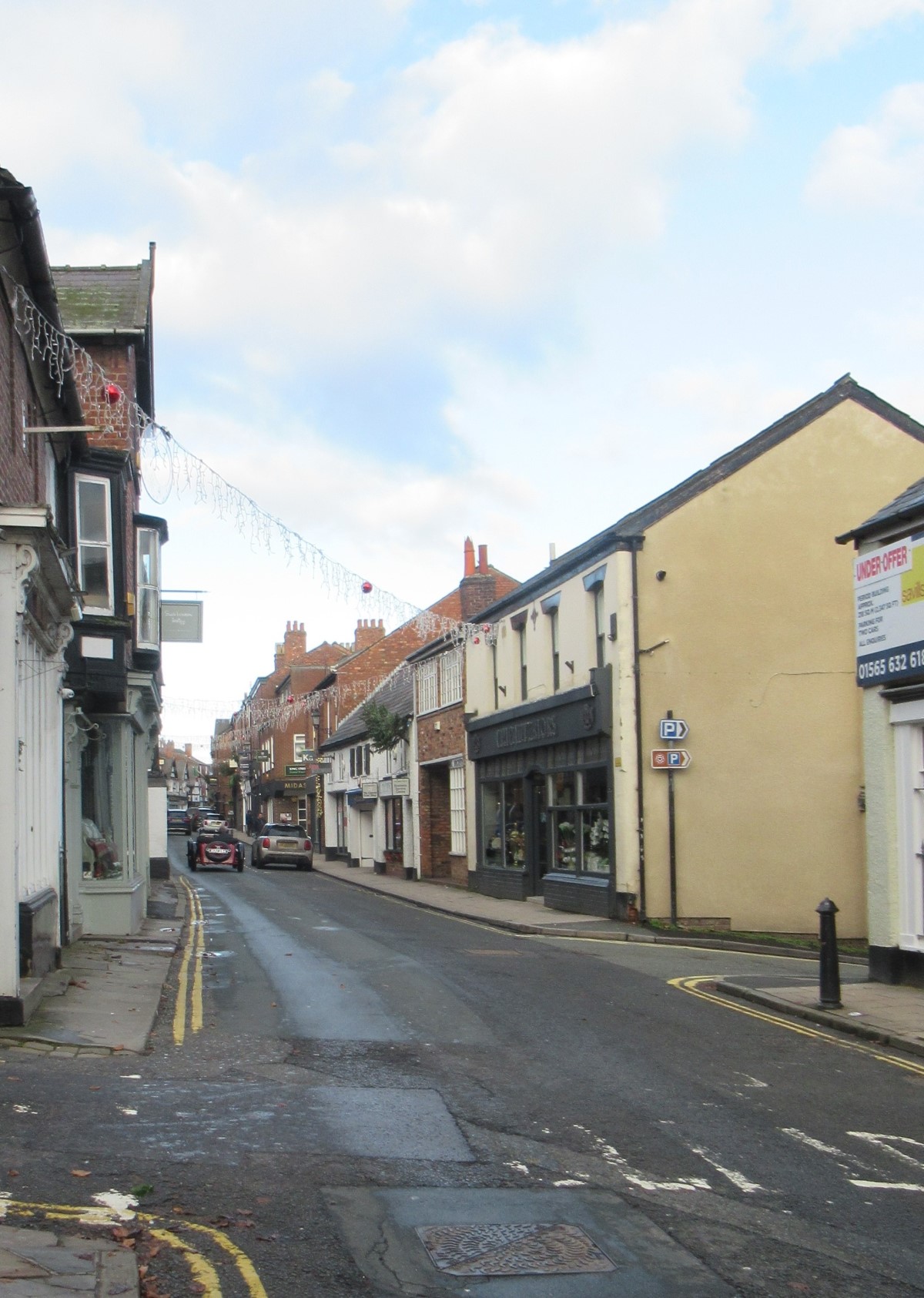
Places: Knutsford


Widget not in any sidebars

Place Type

Chapelry

County

Cheshire

Parish

Rostherne

Deanery

Frodsham

Causes

EDC 5/4/1 – Pernell Danyell contra Joan Walton
EDC 5/14/1 – Elizabeth Smyth, otherwise Rixton, contra Giles Smyth and Margaret Barington.

KNUTSFORD 

In the sixteenth century Knutsford was a chapelry in the parish of Rostherne, about four miles distant. It comprised the townships of Nether Knutsford, Over Knutsford (also known as Knutsford Booths), Toft, Bexton and Ollerton. Although often referred to as a parish at that time it did not become a parish in its own right until an act of parliament in 1741 created ‘a separate and distinct parish’ from the parochial chapelry of Nether Knutsford. (14 Geo. 2 c. 5).

There were two chapels in Knutsford. A chapel is defined by Canon J. S. Purvis as ‘A building regarded as something less than or different from a parish church, or used for less than the full functions of a church.’

The parochial chapel in Nether Knutsford, dedicated to St Helena, was situated in an area known as Crosstown, about a mile from the town centre. This chapel may not have had all the rights of the parish church, although from the number of surviving gravestones it presumably had burial rights. On the creation of the parish a new church, dedicated to St John the Baptist, was built in the centre of the town and the chapel fell into decay and nothing now survives but the footprint of the building and gravestones. The act founding the parish created a vicarage and gave the right of presentation to the lords of the various manors it comprised.

A chapel of ease in the lower town developed from a chantry endowed by Sir John Legh of Booths. This chapel had a school attached. It was not uncommon for chantry priests to take up teaching as their other duties were not onerous and teaching also provide an additional source of income. Following the dissolution of the chantries in the reign of Edward VI a foundation was established to ensure the continuation of the school and chapel. A new schoolhouse was built at the time of the construction of the parish church. In 1697 the chapel warden brought a complaint to the Chester Exchequer on behalf of the inhabitants, claiming that Peter Legh of Booths had locked up the chapel, claiming that it was his domestic chapel and not available for public use without his permission. The Exchequer found in favour of the inhabitants. In the course of the judgement, it was mentioned that the same clergyman usually served both of Knutsford’s chapels.

One deponent in this case stated that in about 1617 a bear had been brought in at service time and allowed to put his paw into the pulpit, which led to the bishop prohibiting all services there for about twelve months until it was re-consecrated, plus the imposition of a fine of £5 (mentioned in Green’s Knutsford, p. 53).

The town of Knutsford was situated on one of the main roads from London to the northwest. A weekly market was held on a Saturday from medieval times. A new market hall, designed by Alfred Waterhouse, was built in 1872 by the Egerton family who had the right to the market tolls. It is now a wine bar. There were also three fairs each year to which cattle were brought from the surrounding countryside. Bear-baiting was a popular entertainment, as indicated by the incident of the bear in the chapel.

The main industry was textiles, initially the manufacture of linen thread from flax grown locally. A silk mill was built in 1770, but both the silk industry and an attempt to introduce cotton spinning failed, perhaps due to inadequate development of the transport infrastructure as industrialisation gathered pace elsewhere.

Knutsford was an important county centre for the administration of justice. From the time of the establishment of the Commission of the Peace for Cheshire in 1536, it was one of the four towns where JPs held their quarterly petty sessions. In the early nineteenth century the county jail and sessions house were built, although quarter sessions had been held in Knutsford since 1575.

The town centre still comprises two narrow streets running almost parallel. The pavements were paid for by Lady Jane Stanley (d. 1803), daughter of the earl of Derby, and were specified by her to be the width of one flagstone. This was said to be because she wished them to be narrow to discourage men and women walking arm-in-arm. She also helped to institute the widespread use of sedan chairs in the town.

Knutsford’s genteel life has been immortalised in Cranford by the Victorian novelist, Elizabeth Gaskell who is commemorated in various parts of the town, including by a building which incorporates a number of influences, including the Arts and Crafts movement. It incorporates a stone bust of her in a niche on its street front and a bronze relief. She spent much of her early life in the town and her husband was minister for a time at the Brook Street Unitarian chapel.

Sources:

Henry Green, Knutsford, its traditions and history: with reminiscences, anecdotes, and notices of the neighbourhood, (London, 1859).

George Ormerod, The History of the County Palatine and City of Chester, (second edition, revised and enlarged by T. Helsby, London, 1882), vol. i, pp. 488-493

Canon J. S. Purvis, Dictionary of Ecclesiastical Terms, (London, 1962), pp. 40-41

‘Knowstone – Kytes-Hardwick’, in A Topographical Dictionary of England, ed. Samuel Lewis (London, 1848), pp. 711-713. British History Online http://www.british-history.ac.uk/topographical-dict/england/pp711-713 [accessed 28 December 2022].

TNA: CHES 14/27, pp. 475-477, 538-541 (with thanks to The Anglo-American Legal Tradition website  http://aalt.law.uh.edu/AALT.html where images of these folios are available).

Click to view fullscreen

People: Walton, Joan


Widget not in any sidebars

Surname

Walton

Forename

Joan

Sex

Female

Parish

Rostherne (Knutsford chapelry)

Marital Status

Unknown

Occupation Status

Servant

Causes

EDC 5/4/1 – defendant

All People

Directory – People

People: Danyell, Robert


Widget not in any sidebars

Surname

Danyell (Daniel/Daniell)

Forename

Robert

Sex

Male

Marital Status

Unknown

Remarks

The allegation against which Pernell Danyell complained, filed as EDC 5/4/1, was that she had an incestuous relationship with her brother, Robert. She may have been the daughter of Peter Daniell of Tabley (near Knutsford), who had a son called Robert and a daughter, Parnell. Peter Daniell died 14 Henry VIII (1522/23) and his wife, Julian, died 20 years later. Robert was their second son.

Sources:

Pedigrees made at the Visitation of Cheshire, 1613, eds. Sir George J. Armytage and J. Paul Rylands (The Record Society of Lancashire and Cheshire, 58, 1909), pp. 70-72


Causes

EDC 5/4/1– named in the libel as brother of the plaintiff

All People

Directory – People

People: Danyell, Pernell


Widget not in any sidebars

Surname

Danyell (Daniel/Daniell)

Forename

Pernell (Parnell)

Sex

Female

Parish

Rostherne (Knutsford chapelry)

Marital Status

Unmarried

Remarks

The allegation against which Pernell Danyell complained, filed as EDC 5/4/1, was that she had an incestuous relationship with her brother, Robert. She may have been the daughter of Peter Daniell of Tabley (near Knutsford), who had a son called Robert and a daughter, Parnell. Peter Daniell died 14 Henry VIII (1522/23) and his wife, Julian, died 20 years later.

Peter Daniell’s daughter, Parnell, married John Brassey or Bressey of Tiverton near Tarporley who died in 1566.

Source: 

Pedigrees made at the Visitation of Cheshire, 1613, eds. Sir George J. Armytage and J. Paul Rylands (The Record Society of Lancashire and Cheshire, 58, 1909), pp. 40, 70-72


Causes

EDC 5/4/1 – plaintiff

All People

Directory – People

People: Carison, John


Widget not in any sidebars

Surname

Carison

Forename

John

Sex

Male

Approx Year of Birth

1502

Parish

Shocklach

Marital Status

Unknown

Causes

EDC 5/3/2 – witness for the plaintiff; his deposition may be found at CALS EDC 2/2 f. 457v

All People

Directory – People

People: Heyton, Ralph


Widget not in any sidebars

Surname

Heyton

Forename

Ralph

Sex

Male

Approx Year of Birth

1508

Parish

Deane

Marital Status

Unknown

Causes

EDC 5/3/2 – witness for the plaintiff; his deposition may be found at CALS EDC 2/2 ff. 457v-457v

All People

Directory – People

People: Crompton, James


Widget not in any sidebars

Surname

Crompton

Forename

James

Sex

Male

Approx Year of Birth

1489

Parish

Deane

Marital Status

Unknown

Causes

EDC 5/3/2 – witness for the plaintiff; his deposition may be found at CALS EDC 2/2 ff. 456v-457

All People

Directory – People

People: Valentine, Thomas


Widget not in any sidebars

Surname

Valentine (Valentyne/ Volantyne)

Forename

Thomas

Sex

Male

Parish

Eccles

Marital Status

Married

Occupation Status

Gentleman

Remarks

Thomas Valentine was the son of John Valentine and his wife, Joan Langtree. The Valentine family, originally from Flixton, occupied Bentcliffe (also known as Bencliffe or Beancliffe) Hall on the eastern outskirts of Eccles. The property remained in the family until it was sold about 1792.

The hall was demolished at the beginning of the nineteenth century as the area became increasingly industrialised.

In 1536 Thomas granted all his lands in Eccles, Barton and Worsley to his illegitimate sons, John and Richard.

The depositions in the causes referred to below indicate that he had been servant of Sir Richard Brereton but the two men had fallen out.

His will, made in March 1550, left the majority of his estate to his son, Richard, who may have been the illegitimate son who had benefited from the transfer of land in 1536. The will does not refer to any other family members. Although the doctrine of purgatory had been publicly debated since the 1540s, and officially condemned at times, the will bequeathed numerous small sums to servants and tenants to pray for his soul, suggesting that Thomas Valentine had remained a staunch Catholic.

There is no date of probate given, but the inventory is dated 8 April 1550, suggesting that the will was made shortly before he died.

Sources:

John Harland (ed.), Mamecestre, Volume 3 (Chetham Society, old series, 58, 1857), p. 492

Rev. G. J. Piccope, (ed.), Lancashire and Cheshire Wills and Inventories from the Ecclesiastical Court, Chester, 3 volumes (Chetham Society, old series, 51, 1860 (Second Portion), pp. 134-135

‘Townships: Barton’, in A History of the County of Lancaster: Volume 4, ed. William Farrer and J Brownbill (London, 1911), pp. 363-376. British History Online http://www.british-history.ac.uk/vch/lancs/vol4/pp363-376 [accessed 8 December 2022]


Causes

EDC 5/3/1 – defendant
EDC 5/3/2 – defendant

All People

Directory – People

People: Holford, Katherine


Widget not in any sidebars

Surname

Holford

Forename

Katherine

Sex

Female

Parish

Great Budworth

Marital Status

At Issue

Spouse Name

John - the defamation suit at EDC 5/1/11 centred upon whether Katherine and John were married

Remarks

John Holford was the eldest son of Robert Holford and his wife, Margery, he had at least five brothers.

John and Katherine were the parents of Francis Holford, who claimed that he had been defamed as a bastard by his uncle, Phillip Holford.


Causes

EDC 5/1/11 – mentioned in the libel; mother of plaintiff

All People

Directory – People

People: Holford, John


Widget not in any sidebars

Surname

Holford

Forename

John

Sex

Male

Parish

Great Budworth

Marital Status

At Issue

Spouse Name

Katherine - the defamation suit at EDC 5/1/11 centred upon whether Katherine and John were married

Occupation Status

Gentleman

Remarks

John Holford was the eldest son of Robert Holford and his wife, Margery, he had at least five brothers.

The family were in dispute about their landholdings and Margery’s will and during her lifetime she expressed concern that ‘hyr sonnes shuld the one kyll the other abowt yt’.

Following Margery’s death by September 1541 a cause relating to the validity of her will was brought in the Chester Consistory Court against Phillip, Urian and Katherine Holford.

Sources:

The Visitation of Cheshire in the year 1580, ed. J. Paul Rylands(The Harleian Society, 18, 1882), p. 125

Depositions in the cause concerning the will of Margery Holford dec’d:
CALS EDC 2/2, pp. 394-398, 412-413


Causes

EDC 5/1/11 – mentioned in the libel; father of plaintiff

All People

Directory – People