Places: Churton Heath


Widget not in any sidebars

Place Type

Chapelry

County

Cheshire

Parish

Chester, St Werburgh

Deanery

Chester

Causes

EDC 5/1575/3 – John Vawdrey and Richard Vawdrey contra Ralph Calveley

CHURTON HEATH

Also known as Church in Heath, Churchenheath, or several other variants, the chapel here was also known as Bruera Chapel. Although it was part of the parish of St Werburgh in Chester, it is situated about six miles south of Chester.

Officials: Downham, William


Widget not in any sidebars

WILLIAM DOWNHAM

First Elizabethan bishop of Chester; actively involved in the work of the consistory court during his episcopate.

WILLIAM DOWNHAM (DOWNAM), bishop of Chester, (c. 1511 – 1577)

Qualifications: Bachelor of Arts 1541; Master of Arts 1543; Doctor of Divinity 1566 (Oxford)

CCEd person ID 65611

Career: brother of the College of Bonhommes at Ashridge, then in Buckinghamshire, until its dissolution in 1539, probably consecrated priest while there, he entered Oxford University in 1539 after the dissolution of the college. He was fellow of Magdalen College by 1543; held a number of parishes, mostly in the diocese of Lincoln all of which he had resigned by the time he became bishop of Chester; archdeacon of Brecon 1559,  canon of Westminster 1560 to 1564. He was appointed chaplain to Princess, later Queen, Elizabeth.

He was consecrated bishop of Chester in May 1561 and held the see until his death in 1577, probably in late November

Further notes: Downham was probably born in Herefordshire and is unlikely to have visited the north-west before his appointment as bishop of Chester. His position as one of Princess Elizabeth’s chaplains during the reign of her Catholic sister, Queen Mary, combined with his ordination as a Catholic priest prior to the break with Rome and his perceived religious conservatism have led to accusations that he remained a Catholic. However, the fact of his marriage by 1554, probably during the reign of the Catholic Queen Mary, would argue against this, since acceptance of clerical marriage was an important theological principle to Protestants. Furthermore, while he was bishop of Chester he insisted on conformity with the Elizabethan Prayer Book and seems to have attempted to follow a middle way between the two extremes of Catholicism and Puritanism, thus alienating both groups, but ‘he had an almost impossible task in remote country’ (Knighton) in one of the poorest sees in the country.

He is also often accused of laziness but he was more assiduous than many contemporary bishops in his supervision of his consistory court. When he arrived in Chester he had no experience of diocesan administration, and familiarised himself with the work of the court by attending almost every general session for the first twelve months he was in Chester and he is invariably addressed as ‘judge’ of the court, so clearly regarded its supervision as his own responsibility and duty. He occasionally presided over court hearings and he also took some depositions, seemingly taking a particular interest in matrimonial causes.

He had two sons and one, or possibly two, daughters and was characterised as ‘a milde, courteous & loueinge man, wisheinge well vnto all’ (Rogers).

Sources:

Christopher Haigh, ‘Finance and administration in a new diocese: Chester, 1541-1641’, in R. O’Day and F. Heal, Continuity and change: personnel and administration of the Church of England, 1500-1642 (Leicester, 1976), pp. 145-66

C. S. Knighton, Downham, William (1510/11-1577) bishop of Chester in , Oxford Dictionary of National Biography (online edition) https://doi.org/10.1093/ref:odnb/7979

David Rogers’ History in British Library, Harley 1948, f. 86v

B. Usher, William Cecil and Episcopacy, 1559-1577 (Aldershot, 2003)

K. R. Wark, Elizabethan Recusancy in Cheshire (Chetham Society, 3rd series, 19, 1971)

F. O. White, Lives of the Elizabethan Bishops of the Anglican Church (London, 1898), pp. 167-171

‘Disbrowe-Dyve’, in Alumni Oxonienses 1500-1714, ed. Joseph Foster( Oxford, 1891), British History Online https://www.british-history.ac.uk/alumni-oxon/1500-1714/pp406-439 [accessed 14 January 2025]

‘Canons (to 1660): Tenth prebend’, in Fasti Ecclesiae Anglicanae 1541-1857: Volume 7, Ely, Norwich, Westminster and Worcester Dioceses, ed. Joyce M Horn( London, 1992), British History Online https://www.british-history.ac.uk/fasti-ecclesiae/1541-1847/vol7/pp80-81 [accessed 14 January 2025]

‘House of Bonhommes: The college of Ashridge’, in A History of the County of Buckingham: Volume 1, ed. William Page( London, 1905), British History Online https://www.british-history.ac.uk/vch/bucks/vol1/pp386-390 [accessed 14 January 2025]


Subjects: Illegitimacy


Widget not in any sidebars

As sexual activity outside marriage was forbidden by the church at this time, matters concerning illegitimate children might be brought before the church courts.

Complaints about child support were, however, increasingly brought before Justices of the Peace although there was no Commission of the Peace in Cheshire until 1536.

Acknowledgement of illegitimate child

The church court could enforce the acknowledgement of paternity of an illegitimate child and sometimes oblige the father to support the child.

EDC 5/9/1 – Francis Buckley contra Elizabeth Traves

Care of illegitimate children

Despite the strictures of the church against illegitimacy, an illegitimate child might be supported by the father without any formal arrangement. In such cases, particularly when the father was a member of the gentry, the care and support of such children might be undertaken by supporters or servants of the family.

EDC 5/3/2 – Sir Richard Brereton contra Thomas Valentine

Types of Cause: Immorality – acknowledgement of illegitimate child


Widget not in any sidebars

The hearing of this type of cause by the Chester church court was unusual by this time, and as the sixteenth century progressed matters of this type were increasingly dealt with by lay authorities.

EDC 5/9/1 Francis Buckley contra Elizabeth Traves

Officials: Knight, William


Widget not in any sidebars

WILLIAM KNIGHT

Nominally in charge of the Chester Consistory Court during his period in office as archdeacon of Chester, he delegated oversight of the court to official principals including Adam Beconsall.

WILLIAM KNIGHT, 1475/6 – 1547

Qualifications: fellow of New College, Oxford in 1493; Bachelor of Canon Law by 1504; Doctor of Canon Law by 1506 (Oxford); much influenced by a period of education in Italy

CCEd person ID 147690

Career: He was secretary to both Henry VII and Henry VIII and as such was sent abroad on a number of important diplomatic missions. He held several ecclesiastical positions, including parishes such as Preston in Lancashire and canonries including at Lincon, St Paul’s and Bangor, he was a notable pluralist.

He was appointed archdeacon of Chester in 1522 and was the last archdeacon to head the consistory court before the foundation of Chester diocese in 1541.

He was also appointed archdeacon of Huntingdon and Richmond while archdeacon of Chester. His holding of the contiguous archdeaconries of Chester and of Richmond may have facilitated their combination as the diocese of Chester in 1541 at which date he surrendered these archdeaconries and was appointed bishop of Bath and Wells. He held that see until his death in 1547; a religious conservative.

Further notes: ‘ one of the best rewarded clerical careerists of his age’. (Clark)

Sources:

Richard Clark, ‘Knight, William (1475/6-1547), Oxford Dictionary of National Biography (online edition) https://doi.org/10.1093/ref:odnb/15738

Peter Heath, ‘The Medieval Archdeaconry and Tudor Bishopric of Chester’, Journal of Ecclesiastical History, 20 (2) (1969), pp. 243-52

‘Kandruth-Kyte’, in Alumni Oxonienses 1500-1714, ed. Joseph Foster( Oxford, 1891), British History Online https://www.british-history.ac.uk/alumni-oxon/1500-1714/pp837-867

Joyce M Horn, David M Smith, Patrick Mussett, ‘Archdeacons: Chester’, in Fasti Ecclesiae Anglicanae 1541-1857: Volume 11, Carlisle, Chester, Durham, Manchester, Ripon, and Sodor and Man Dioceses( London, 2004), British History Online https://www.british-history.ac.uk/fasti-ecclesiae/1541-1847/vol11/pp45-47 [accessed 14 January 2025]

Joyce M Horn, David M Smith, Patrick Mussett, ‘Archdeacons: Richmond’, in Fasti Ecclesiae Anglicanae 1541-1857: Volume 11, Carlisle, Chester, Durham, Manchester, Ripon, and Sodor and Man Dioceses( London, 2004), British History Online https://www.british-history.ac.uk/fasti-ecclesiae/1541-1847/vol11/pp47-49 [accessed 14 January 2025]


Officials: Wydhope, Richard


Widget not in any sidebars

RICHARD WYDHOPE

Scribe and registrar of the court, the precise dates during which he held this office are not known.

RICHARD WYDHOPE fl. 1526-1528

Registrar of the Court

Qualifications: Notary Public

Sources:

Rev. G. J. Piccope, (ed.), Lancashire and Cheshire wills and inventories from the Ecclesiastical Court, Chester, (Chetham Society, old series, 33, 1857 (First Portion)), p. 29.

Subjects: Witnesses


Widget not in any sidebars

Witnesses were not only summoned to make statements, or depositions, but might be required for other matters such a attestation of virginity in matrimonial causes or as hands where compurgation was ordered.

Age of witnesses

EDC 5/1580/10 – Anne Jackson contra Anne Jones, wife of Thomas Jones. The defendant sought to discredit one of the witnesses on the grounds of age as he was not yet 20 and should not have been admitted as a witness as he was under 25.

Independence

Witnesses were supposed to be disinterested parties and exceptions against witnesses often included a claim that a particular witness was biased in an effort to discredit his or her deposition.

EDC 5/3/2 – Sir Richard Brereton contra Thomas Valentine

Virginity

A claim for a marriage to be annulled might succeed if it could be proved that the marriage had not be consummated as the wife was still a virgin. This would be established by a physical examination, usually carried out by a number of  ‘honest and willing matrons’ as witnesses.

EDC 5/1/1 – Ellen Knottisford contra Ralph Bury

Women as witnesses

Attempts might be made to discredit the evidence of women witnesses because they were said to be unreliable on account of their sex.

EDC 5/1575/2 – Ellen Bamvile contra Rose Smith

Proctors: Parkinson, Robert


Widget not in any sidebars

ROBERT PARKINSON

Proctor at Chester from about 1564.

ROBERT PARKINSON

Qualifications: probably of Oxford; Bachelor of Arts 5 November 1561.

Sources:

‘Pace-Payton’, in Alumni Oxonienses 1500-1714, ed. Joseph Foster (Oxford, 1891), pp. 1104-1131. British History Online http://www.british-history.ac.uk/alumni-oxon/1500-1714/pp1104-1131

CAUSES:

ReferenceType of causeRoleOutcomeNotes
EDC 5/1566/9Defamation - sexual slander  Proctor  for defendant Not known

Proctors: Man, William


Widget not in any sidebars

WILLIAM MAN

Notary public and rural dean of Warrington and Wirral

WILLIAM MAN, d. 1585

Qualifications: probably of Christ Church, Oxford, 1551; Bachelor of Arts 26 January 1555, Master of Arts 20 October 1558. Proctor at Chester from late 1561. If this is the same man, he was at Christ Church at the same time as Robert Leche, Chancellor of the diocese of Chester.

CCEd person ID 32107

Career: possibly vicar of Rickmansworth in 1559; rural dean of Warrington from about 1573; rural dean of Wirral 1582.

Further notes: It seems likely that he was the man of that name who was summoned to appear before the Ecclesiastical Commissioners on 30 April 1565 accused of fornication and was ordered to carry out the humiliating penance of appearing in St Peter’s church in Chester on a Saturday with bare feet and legs and without a hat and with a paper pinned to his shirt saying ‘Fornicator apon Easter daie at night’ and to go from the church through the Corn Market and then to stand on a ‘scaffold’ in the market place and publicly declare his offence. From there he was to go into the cathedral and offer 12d for the poor. It was often possible in offences like this arising from visitation presentments to commute such humiliating public penance for a cash payment to a charitable cause but this was not offered to Man. He refused to carry out the penance and also arranged for his co-accused, Jane Ruttor, to be illicitly released from prison. He was committed to gaol in Chester Castle but unfortunately no further record survives to show how he gained his liberty. Two of the Ecclesiastical Commissioners who imposed this penalty were William Downham, bishop of Chester, and Robert Leche. (CALS EDA 12/2 ff. 97, 98, 99v.) Man probably subsequently married Jane Ruttor as a cause from 1575/1576 was brought by Jane Man, wife of William Man, Master of Arts; she died as his widow in 1592.

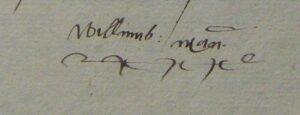
The signature of William Man from CALS EDC 1/10, f. 433

Sources:

CALS EDA 12/2 ff. 97, 98, 98v.

‘Mab-Marygold’, in Alumni Oxonienses 1500-1714, ed. Joseph Foster (Oxford, 1891), pp. 956-982. British History Online https://www.british-history.ac.uk/alumni-oxon/1500-1714/pp956-982


CAUSES:

ReferenceType of causeRoleOutcomeNotes
EDC 5/1566/1 Matrimonial - restitution of conjugal rightsProctor for plaintiff  Plaintiff wonThe defendant did not answer any citation or turn up in court
EDC 5/1566/8   Tithes - barley and hay   Proctor for plaintiff Plaintiff won
EDC 5/1566/9 Defamation - sexual slander      Proctor  for plaintiff   Not known
EDC 5/1566/10Defamation - sexual slander    Proctor for plaintiffPlaintiff won
EDC 5/1566/12Tithes - calves, cows, gardens, lambs, sheep, wool Proctor for plaintiffDefendant wonThis was an unusual loss for a plaintiff and for William Man
EDC 5/1566/14Tithes - unknown Proctor for plaintiff Plaintiff won
EDC 5/1566/15Tithes - hay   Proctor for plaintiff Plaintiff won
EDC 5/1575/3 Tithes - grain   Proctor for defendantNot known
EDC 5/1575/15Tithes - hay   Proctor for plaintiff Plaintiff won
EDC 5/1580/2Matrimonial - separation from bed and board: adulteryProctor for plaintiff Plaintiff won


Officials: Leche, Robert


Widget not in any sidebars

ROBERT LECHE

Chancellor and vicar general in spirituals of the diocese of Chester and official principal of the Chester consistory court 1562-1587.

ROBERT LECHE, d. 1587

Qualifications: of Christ Church, Oxford, 1550; Bachelor of Arts; Master of Arts 30 May 1555, proctor 1560 and 1566; Bachelor of Civil Law 5 February 1561, Doctor of Civil Law 14 July 1567.

CCEd person ID 84631

Career: commissary to the archbishop of York during his visitation 1561-2;  chancellor and vicar general in spirituals of the diocese of Chester and official principal of the Chester consistory court 1562-1587; rural dean of Chester, Malpas and Wirral 1563; keeper of spiritualties of the diocese of Chester 1577 sede vacante

 Further notes: Robert Leche was from a Chester family, his oldest brother was a merchant in the city and he married Anne Webster, daughter of a Chester alderman

The signature of Robert Leche from EDA 12/2, f. 108v.

Sources:

F. C. Beazley, ‘Wirral records of the 17th century’, Transactions of the Historic Society of Lancashire and Cheshire, 77 (1925), pp. 137-140.

Christopher Haigh, Reformation and Resistance in Tudor Lancashire (Cambridge, 1975), p. 228.

George Ormerod, The History of the County Palatine and City of Chester, (second edition, revised and enlarged by T. Helsby, 3 vols, London, 1882), vol i, p. 113, vol ii, p. 617.

Frank Simpson, ‘Leche House, Chester’, Journal of the Chester and North Wales, Archaeological & Historic Society, new series, 21 (1915), p. 8.

 Cheshire Sheaf, 3rd series, xliii, p. 41; 3rd series, xlix, p. 31.

‘Labdon-Ledsam’, in Alumni Oxonienses 1500-1714, ed. Joseph Foster( Oxford, 1891), British History Online https://www.british-history.ac.uk/alumni-oxon/1500-1714/pp868-892 [accessed 14 January 2025]