People: Hilton, William


Widget not in any sidebars

Surname

Hilton (Hulton)

Forename

William

Sex

Male

Parish

Eccles

Marital Status

Unknown

Causes

EDC 5/2/1 – defendant


All People

Directory – People

People: Forster, Hugh


Widget not in any sidebars

Surname

Forster (Forstar/ Forstart)

Forename

Hugh

Sex

Male

Parish

Eccles

Marital Status

Unknown

Causes

EDC 5/2/1 – defendant


All People

Directory – People

People: Lee, Thomas


Widget not in any sidebars

Surname

Lee (Le)

Forename

Thomas

Sex

Male

Parish

Eccles

Marital Status

Unknown

Causes

EDC 5/2/1 – defendant


All People

Directory – People

People: Bradshaw, Peter


Widget not in any sidebars

Surname

Bradshaw (Bradshae)

Forename

Peter

Sex

Male

Parish

Eccles

Marital Status

Unknown

Causes

EDC 5/2/1 – defendant


All People

Directory – People

People: Penne, John


Widget not in any sidebars

Surname

Penne (Penn/Pen)

Forename

John

Sex

Male

Marital Status

Married

Spouse Name

Lucy

Occupation Status

Barber to Henry VIII

Remarks

John Penne (Penn/Pen) was a Groom of the Privy Chamber.  In 1527 he was admitted to The Worshipful Company of Barbers in London and was Master of the Company in 1539. He was appointed barber to Henry VIII and at one time was one of only fifteen people permitted to enter the King’s Privy Chamber.

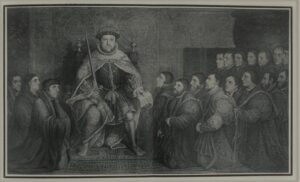
He appears in Holbein’s oil painting of Henry VIII and the Barber Surgeons, and in an engraved copy of the painting from 1736 he appears in the group of men kneeling, sixth from the King’s left.

As a courtier he received a number of grants and leases of land in several counties, including the manor of Codicote in Hertfordshire which was granted to him in 1545 following the dissolution of the Abbey of St Albans.

On 16 February 1538 he had been granted a lease of the rectory of Eccles in Lancashire, following the dissolution of Whalley Abbey but the lease was forfeit because the rent remained unpaid. He was one of several courtiers who profited from the dissolution of the monasteries.

In the early years of the reign of Henry VIII, he married Lucy, daughter and heiress of Edmond Cheval who held the manor of Sisserfens in Codicote.

He died on 21 August 1558.

The image of Henry VIII and the Barber-Surgeons is reproduced from Young, The Annals of the Barber-Surgeons of London, courtesy of the Hathi Trust.

Sources:

Sidney Young, The Annals of the Barber-Surgeons of London, Compiled from their Records and other Sources (London, 1890), pp. 525-527

TNA: PROB 11/42B/160

‘Parishes: Codicote’, in A History of the County of Hertford: Volume 2, ed. William Page (London, 1908), pp. 345-348. British History Online http://www.british-history.ac.uk/vch/herts/vol2/pp345-348 [accessed 28 November 2022]

‘Henry VIII: April 1545, 26-30’, in Letters and Papers, Foreign and Domestic, Henry VIII, Volume 20 Part 1, January-July 1545, ed. James Gairdner and R H Brodie (London, 1905), pp. 278-329. British History Online http://www.british-history.ac.uk/letters-papers-hen8/vol20/no1/pp278-329 [accessed 28 November 2022]


Causes

EDC 5/2/1 – mentioned in the libel as holder of the head lease of the disputed tithes


All People

Directory – People

People: Brereton, Sir Richard


Widget not in any sidebars

Surname

Brereton (Brerton)

Forename

Richard

Sex

Male

Marital Status

Married

Spouse Name

Jane or Joan

Occupation Status

Knight

Remarks

Sir Richard Brereton was the second son of Sir Randle Brereton of Malpas and older brother of the courtier, William Brereton, and the pluralist cleric and royal chaplain, John Brereton.

He married Jane or Joan, daughter and heiress of William Stanley of Tatton. She was also great-niece of Thomas Stanley, 1st earl of Derby. Sir Richard was her second husband. Jane Stanley inherited the Manor of Worsley in the parish of Eccles in Lancashire. She was born about 1493, as she was 18 on the death of her mother in 1511.

In 1542 Lady Brereton sued her husband in the Chester Consistory Court for divorce (which would have meant separation from bed and board). Some depositions in this matter have survived (CCALS EDC 2/2 ff. 448-449, 545v). The deponents all cited a number of extra-marital relationships on the part of Richard Brereton which had resulted in several illegitimate children, some of whom he acknowledged and some he did not. It was said to be widely known that one of his mistresses had suffered from ‘the french pokkes’, a common name for syphilis. Two deponents specifically mentioned this illness so there may have been reference to it in the libel.

He had three legitimate children, the eldest, Richard, was accused by his father of taking a chalice from the chapel in his manor of Worsley, among other criminal deeds. Richard predeceased his father.

Sir Richard Brereton died in 1557 in Islington, then in Middlesex.

His will, made in 1553, acknowledged four illegitimate sons and two daughters, leaving legacies to each of them. His will was disputed by his widow and his surviving legitimate son, Geoffrey, but was held to be valid.

Sources:

George Ormerod, The History of the County Palatine and City of Chester (second edition, revised and enlarged by T. Helsby, London, 1882), vol. 1, p.443; vol. 2, pp. 686-688

TNA: PROB 11/40/343

‘Townships: Worsley’, in A History of the County of Lancaster: Volume 4, ed. William Farrer and J Brownbill (London, 1911), pp. 376-392. British History Online http://www.british-history.ac.uk/vch/lancs/vol4/pp376-392 [accessed 28 November 2022]

Causes

EDC 5/2/1 – plaintiff
EDC 5/3/1 – plaintiff
EDC 5/3/2 – plaintiff – exceptions against one witness included the fact that he was looking after one of Sir Richard Brereton’s illegitimate children

All People

Directory – People

Places: Deane


Widget not in any sidebars

Place Type

Parish

County

Lancashire

Parish

Eccles

Deanery

Manchester

Causes

EDC 5/2/1 – Sir Richard Brereton contra William Hilton, Thomas Lee, Hugh Forstar and Peter Bradshaw
EDC 5/3/1 – Sir Richard Brereton contra Thomas Valentine
EDC 5/3/2 – Sir Richard Brereton contra Thomas Valentine


DEANE

Deane was a chapelry of the parish of Eccles, owned by Whalley Abbey, until, in 1541, it became an independent parish in the gift of the Crown by letters patent of Henry VIII, patron following the dissolution of the abbey in 1537. In 1545 the vicar of Eccles deposed that the parishioners of Deane had petitioned for the creation of the parish because they objected to having to contribute to the building costs of Eccles church. The parish comprised the townships of Heaton, Middle Hulton, Rumworth, Farnworth and Kearsley, plus the chapelries of Halliwell, Horwich, Little Hulton and Westhoughton.

Before 1541 the priests who officiated at Deane had been appointed by the vicars of Eccles who paid them an annual salary of £4, but thereafter as they had no power to appoint or remove the new vicar, they refused to pay him. Moreover, they claimed that the income of the parish of Eccles was diminished by the consequent loss of fees.

In February 1538 a lease of the rectory of Eccles ‘and the chapel of Deane, annexed to it’ had been granted to John Penne, the royal barber, who had extensive estates in Hertfordshire. However, because John Penne had not paid the rent the lease was transferred to Thomas Holcroft in 1545.

The parish of Deane was a discharged vicarage which means that any vicar was ‘dischardged and acquited for ever’ from payment of a tax called first-fruits on taking over the vicarage because the value of the living was under £10 per annum.

The church building has apparently developed from a small fourteenth-century building to which additions and alterations were made over the following centuries, some of which were not popular. In 1522 Richard Heaton of Heaton complained to the court of the Duchy of Lancashire that he had constructed an ‘Ile’ within the church, with a ‘chappell of tymbre’ containing an altar where Mass was said regularly. A group of about forty men demolished the wooden structure during the night and got rid of all the timber.

Despite such disagreements, the building was subsequently altered and extended, although the west tower and north doorway are fourteenth century. There was a comprehensive enlargement and reconstruction in the nineteenth century.

In the churchyard is a memorial to George Marsh, the Protestant martyr, who was born in the parish of Deane and taken prisoner while preaching there. Immediately after his arrest he was taken to Smithills Hall in the township of Halliwell, before being transferred to prison and then to Chester, where he was tried in the Consistory Court and burned at the stake in 1555.

A large part of the parish is now within the Bolton conurbation and the textile industry has been important in the area, with handloom weaving and the later development of cotton mills. There were also extensive bleach works in the area. The parish is situated on the Lancashire coalfield and mining became an important industry.

Field names 

named in EDC 5/2/1
derlayglad hey
radford
mutchaw the new marled yerth in the hyll
the newe close mosse Filde
barli crofft
the heythe

horhey medo
steward medo
chodlachmedo

Sources:

Pleadings and depositions in the Duchy Court of Lancaster Part 1, Henry VII and Henry VIII, ed. Henry Fishwick (The Record Society of Lancashire and Cheshire, 32, 1896), p. 111

Pleadings and depositions in the Duchy Court of Lancaster Part 2, Henry VIII, ed. Henry Fishwick (The Record Society of Lancashire and Cheshire, 35, 1897), pp. 197-199

‘Deane – Dembleby’, in A Topographical Dictionary of England, ed. Samuel Lewis (London, 1848), pp. 23-28. British History Online http://www.british-history.ac.uk/topographical-dict/england/pp23-28[accessed 28 November 2022]

‘Salford hundred: The parish of Deane’, in A History of the County of Lancaster: Volume 5, ed. William Farrer and J Brownbill (London, 1911), pp. 1-5. British History Online http://www.british-history.ac.uk/vch/lancs/vol5/pp1-5 [accessed 28 November 2022]

‘Henry VIII: April 1545, 26-30’, in Letters and Papers, Foreign and Domestic, Henry VIII, Volume 20 Part 1, January-July 1545, ed. James Gairdner and R H Brodie (London, 1905), pp. 278-329. British History Online http://www.british-history.ac.uk/letters-papers-hen8/vol20/no1/pp278-329 [accessed 28 November 2022]

Click to view fullscreen

Places: Eccles


Widget not in any sidebars

Place Type

Parish

County

Lancashire

Parish

Eccles

Deanery

Manchester

Causes

EDC 5/2/1 – Sir Richard Brereton contra William Hilton, Thomas Lee, Hugh Forstar and Peter Bradshaw
EDC 5/3/1 – Sir Richard Brereton contra Thomas Valentine
EDC 5/3/2 – Sir Richard Brereton contra Thomas Valentine
EDC 5/9/3 – William Renshaye contra Clement Bent alias Renshaye


ECCLES

The benefice of Eccles had been granted to Stanlow (or Stanlaw) Abbey in Cheshire in the early thirteenth century, and at that time Deane was one of its chapelries. The abbey at Stanlow was situated on the banks of the River Mersey and was liable to flooding, so by the end of the thirteenth century the majority of the monks had moved to Whalley, where the Abbey became one of the most important and wealthy Cistercian houses in the country.

The monks of Whalley provided a vicar for Eccles, which became a parish in the gift of the Crown following the monastery’s dissolution in 1537. In February 1538 a lease of the rectory of Eccles ‘and the chapel of Deane, annexed to it’ was granted to John Penne, the royal barber, who had extensive estates in Hertfordshire. However, because John Penne had not paid the rent the lease was transferred to Thomas Holcroft in 1545.

It was a discharged vicarage which means that any vicar of Eccles was ‘dischardged and acquited for ever’ from payment of a tax called first-fruits on taking over the vicarage because the value of the living was under £10 per annum. Thus, although the Crown retained the rights to all the tithes and other church dues of the parish, the vicar who served the parish was not very well paid.

A plaque in the church records that in 1541 10 townships were separated off to form the parish of Deane. Following this, the parish of Eccles comprised the townships of Barton, Clifton, Pendlebury and the chapelries of Pendleton and Worsley.

The parish church building is in the later English style and although there has been a church here since Norman times, the earliest surviving parts of the present building are said to date from the thirteenth-century, including the base of the tower. Fourteenth-century elements include the arch leading into the south transept and the studded inner door of the south porch. The church may have been built on the site of an earlier chapel as part of a Celtic cross was discovered nearby. The building was comprehensively reconstructed in the fifteenth and sixteenth centuries but then remained virtually unchanged until the nineteenth century when it was, again, substantially restored in 1862. The tomb of Richard Brereton and his wife and son survives from the seventeenth century. The brass plates on the ends of the pews record who was entitled to sit in them.

The church, which is listed Grade 1 on the National Heritage List for England, is now surrounded by high-rise blocks and a shopping centre, and the churchyard has mostly been grassed over.

The area of the parish included part of Chat Moss, moss being the local word for a peat bog. This area was waste until drainage schemes began in the early nineteenth century, and it has now largely been reclaimed. Most of the agriculture in the parish consisted of grazing and there was little arable land until this reclamation. Coal mining had begun in the parish by the sixteenth century and the development of canals in the eighteenth century stimulated development not only of the coal industry, but also textile weaving and spinning. A war memorial in the church records employees of Eccles Spinning Company Ltd. who served in the First World War.

Eccles is a market town, now part of Salford, and has given its name to the famous Eccles cakes.

Field names include:

named in EDC 5/2/1 –
the heythe

Sources:

Dom Gilbert Dolan, O.S.B., ‘Notes on the ancient religious houses of the County of Lancaster’, Transactions of the Historic Society of Lancashire and Cheshire, vols. 43 and 44 (1891 and 1892), pp. 228-229. Available online:
https://www.hslc.org.uk/journal/vol-43-1891-and-vol-44-1892/

The Statutes of the Realm; volume the fourth (London, 1719, reprinted 1963). (1 Elizabeth, c. 4).

‘Eaton-Hastings – Eccleshill’, in A Topographical Dictionary of England, ed. Samuel Lewis (London, 1848), pp. 136-139. British History Online https://www.british-history.ac.uk/topographical-dict/england/pp136-139

‘The parish of Eccles: Introduction, church and charities’, in A History of the County of Lancaster: Volume 4, ed. William Farrer and J Brownbill (London, 1911), pp. 352-362. British History Online https://www.british-history.ac.uk/vch/lancs/vol4/pp352-362

‘Henry VIII: April 1545, 26-30’, in Letters and Papers, Foreign and Domestic, Henry VIII, Volume 20 Part 1, January-July 1545, ed. James Gairdner and R H Brodie (London, 1905), pp. 278-329. British History Online https://www.british-history.ac.uk/letters-papers-hen8/vol20/no1/pp278-329 (vol 20 Part 1, no 19 (9))

Historic England:
Church of St Mary (1067498)
https://historicengland.org.uk/listing/the-list/list-entry/1067498 National Heritage List for England

Click to view fullscreen

People: Holford, Francis


Widget not in any sidebars

Surname

Holford

Forename

Francis

Sex

Male

Approx Year of Birth

1518

Parish

Great Budworth

Marital Status

Unknown

Remarks


Career:
Francis Holford was the son of John Holford one of the sons of Robert Holford and his wife, Margery.  John was probably the oldest of Robert and Margery’s children.

The family seem to have been at loggerheads about their landholdings and Margery’s will and during her lifetime she expressed concern that ‘hyr sonnes shuld the one kyll the other abowt yt’.

Sources:

Depositions in the cause concerning the will of Margery Holford dec’d:
CALS EDC 2/2, pp. 394-398, 412-413


Causes

EDC 5/1/11 – plaintiff

All People

Directory – People

People: Holford, Philip


Widget not in any sidebars

Surname

Holford

Forename

Philip

Sex

Male

Parish

Great Budworth

Marital Status

Unknown

Remarks


Philip Holford was the son of Robert Holford and his wife, Margery.  He was probably the second of their sons, John being his older brother.

The family were in dispute about their landholdings and Margery’s will and during her lifetime she expressed concern that ‘hyr sonnes shuld the one kyll the other abowt yt’.

Following Margery’s death by September 1541 a cause relating to the validity of her will was brought in the Chester Consistory Court against Philip, Urian and Katherine Holford. One of the deponents in this cause was Sir Thomas Egerton, probably chaplain at the chapel of Lower Peover, and godfather to one of Philip’s children. He was said to be at loggerheads with Brian Holford, one of Philip’s brothers.

Sources:

The Visitation of Cheshire in the year 1580, ed. J. Paul Rylands (The Harleian Society, 18, 1882), p. 125

Depositions in the cause concerning the will of Margery Holford dec’d:
CALS EDC 2/2, pp. 394-398, 412-413


Causes

EDC 5/1/11 – defendant

All People

Directory – People