People: Jones, Anne


Widget not in any sidebars

Surname

Jones (Johnes)

Forename

Anne

Sex

Female

Parish

Middleton

Marital Status

Married

Spouse Name

Thomas

Causes

EDC 5/1580/10 – defendant

All People

Directory – People

People: Jackson, Anne


Widget not in any sidebars

Surname

Jackson

Forename

Anne

Sex

Female

Parish

Middleton

Marital Status

Unmarried

Remarks

The depositions state that she had a brother called Ambrose.

Causes

EDC 5/1580/10 – plaintiff

All People

Directory – People

People: Williamson, Thomas


Widget not in any sidebars

Surname

Williamson

Forename

Thomas

Sex

Male

Marital Status

Married

Spouse Name

Jane

Occupation Status

Clerk; fellow of Manchester College; vicar of Eccles

Literacy

Yes - graduate

Remarks

CCEd person ID 29173

Career: As a boy, Thomas Williamson probably attended Sedbergh School and entered St. John’s College, Cambridge in 1567. As Master of Arts Williamson was appointed vicar of Eccles by Queen Elizabeth in 1576 and, together with Oliver Carter, was one of the first Fellows of Manchester College when it was re-founded by her in 1578, holding the position until his death in 1606. He also held the vicarage of Childwall for a few months in 1588/9.

Further notes:

He represented Manchester College at a metropolitan visitation in 1590, when it was found that none of the fellows wore a surplice, a practice associated with Puritanism, which was not accepted by the church authorities. He had already been ordered to wear a surplice during a previous metropolitan visitation of his parish of Eccles in 1578.

In 1584 he was appointed as one of the Bury moderators of the monthly preaching and educational Exercises held for clergy throughout the diocese. These were intended to win over those inclined to conservatism and to improve standards but are associated with Puritanism.

Sources: 

F. R. Raines, The fellows of the collegiate church of Manchester, ed. F. Renaud, vol. 1, Chetham Society, new series, 21 (1891).

F. R. Raines (ed.), ‘A Visitation of the diocese of Chester, by John, Archbishop of York, held in the Chapter House of the Collegiate and Parish Church of Manchester, 1590, with the Archbishop’s correspondence with the clergy.’ Chetham Miscellanies, vol. v, Chetham Society, old series, 96 (1875).

R. C. Richardson, Puritanism in north-west England (Manchester, 1972).

B. Wilson (ed.), The Sedbergh School Register 1546 to 1895 (Leeds, 1895).

https://www.british-history.ac.uk/vch/lancs/vol4/pp352-362#anchorn60

Causes

EDC 5/1580/10 – commissioned to examine witnesses in Manchester

All People

Directory – People

People: Richardson, Thomas


Widget not in any sidebars

Surname

Richardson

Forename

Thomas

Sex

Male

Marital Status

Married

Occupation Status

Clerk; fellow of Manchester College; rector of Ashton-upon-Mersey; rural dean of Manchester

Literacy

Yes - owned a number of books

Remarks

CCEd person ID 35050

Career: Thomas Richardson became a Fellow of Manchester College by 1574 and retained the position until his death in 1613. In 1583 he was presented to the rectory of Ashton upon Mersey, where in 1592 he was classified amongst the group who were ‘no graduates, but preachers, honest men’.  He became rural dean of Manchester deanery, possibly in 1574 following the death of Peter Shaw, the previous dean.

Further notes: 

In 1599 he was involved with other rural deans of the diocese of Chester in a jurisdictional dispute which was appealed to York.

 Sources: 

F. R. Raines, The fellows of the collegiate church of Manchester, ed. F. Renaud, vol. 1, Chetham Society, new series, 21 (1891).

Causes

EDC 5/1580/10 – commissioned to examine witnesses in Manchester

All People

Directory – People

People: Carter, Oliver


Widget not in any sidebars

Surname

Carter (Cartar)

Forename

Oliver

Sex

Male

Marital Status

Married

Spouse Name

First wife - Emma; second wife - Alice

Occupation Status

Clerk; fellow of Manchester College

Literacy

Yes - graduate

Remarks

CCEd person ID 22503

Career: Oliver Carter was from Richmondshire, parts of which were in Yorkshire and parts in north Lancashire. He graduated from St John’s College Cambridge with a BA in 1560, MA in 1563 and as a Bachelor of Divinity in 1569, having been appointed one of the College preachers in 1565 and a University preacher in 1567. After parish appointments near Cambridge, he became a Fellow of Manchester College by 1573, where he remained until his death in 1605. In 1578 was appointed by the bishop of Chester as one of the moderators of the Manchester monthly lecture, an institution associated with evangelical Protestantism.

Further notes: 

Manchester College suffered from serious financial problems following its dissolution under Edward VI and restoration under Mary and so was re-founded by Elizabeth in 1578. Carter was, however, himself beset by financial difficulties being obliged to borrow money and to sue the College for unpaid stipend. He thus took on extra work such as tutoring and drawing up wills which distracted from his work as an evangelical.

Henry, earl of Derby was a patron, and he dedicated his 1579 book refuting some Catholic claims to the earl and also preached to the earl and his household. His evangelical views are also evidenced by his presentation to the church authorities for refusing to wear a surplice and his opposition to use of the organ in services. 

Sources:

F. R. Raines, The fellows of the collegiate church of Manchester, ed. F. Renaud, vol. 1, Chetham Society, new series, 21 (1891).

“Carter, Oliver”. Oxford Dictionary of National Biography (online ed.). Oxford University Press. doi.org/10.1093/ref:odnb/4795

Causes

EDC 5/1580/10 – commissioned to examine witnesses in Manchester

All People

Directory – People

Places: Accrington


Widget not in any sidebars

Place Type

Township

County

Lancashire

Parish

Whalley

Deanery

Blackburn

Causes

EDC 5/1580/10 – Anne Jackson contra Anne Jones, wife of Thomas Jones

ACCRINGTON

Accrington, in the parish of Whalley, comprised two townships – Old Accrington and New Accrington – which were united in 1878.

The agricultural land of the area is mainly pasture. By 1830 textile industries were developing in the town, notably calico weaving and printing and cotton spinning. Associated works producing textile machinery also grew up. From the fifteenth century there were collieries, quarries and mines in the area. The town was also famous for the manufacture of bricks.

There was a chapel at Accrington which was confiscated as a chantry in about 1547, but subsequently restored in 1553 on payment of a fee. The vicars of Whalley were responsible for maintaining worship there, and the chapel did not usually have its own minister. The chapel was demolished and rebuilt in 1826.

Sources:

‘Townships: Old and New Accrington’, in A History of the County of Lancaster: Volume 6, ed. William Farrer, J Brownbill( London, 1911), British History Online https://www.british-history.ac.uk/vch/lancs/vol6/pp423-427

‘Abingdon – Ackton’, in A Topographical Dictionary of England, ed. Samuel Lewis( London, 1848), British History Online https://www.british-history.ac.uk/topographical-dict/england/pp5-9


Places: Middleton


Widget not in any sidebars

Place Type

Parish

County

Lancashire

Deanery

Manchester

Causes

EDC 5/12/1 – Robert Assheton, rector of Middleton, contra John Aspinall, John Allens and John Bradley.
EDC 5/13/3 – Robert Assheton, rector of Middleton, contra Giles Johnson.
EDC 5/1580/10 – Anne Jackson contra Anne Jones, wife of Thomas Jones.


MIDDLETON

The parish comprised Middleton, Pilsworth, Hopwood, Thornham, Great Lever, Ashworth, Ainsworth and Birtle-cum-Bamford, the last four being detached from the main parish.

The original parish church or chapel was built before 1066 and was dedicated to St Cuthbert, following the Norman Conquest a new church was built and dedicated to St Leonard. However, there is still a side chapel dedicated to St Cuthbert.

The church was entirely rebuilt in the early fifteenth century by Cardinal Thomas Langley, Lord Privy Seal and archdeacon of York, who was a native of Middleton. His building incorporated some remains of earlier building such as the arch between the tower and the nave (thought to be twelfth century).

The church building underwent further reconstruction a century later when Richard Assheton, lord of the manor of Middleton, enlarged it considerably and added the clerestory.

Subsequent rebuilding included the addition to the tower of its unusual wooden cap. The church retains many early features, however, including the rood screen and other early woodwork, together with some stained glass.

The advowson always belonged to the owner of the manor of Middleton which remained in the Assheton family for centuries. Many of the sixteenth-century rectors of the parish were family members.

Coal mines in Thornham and Hopwood helped to fuel the development of the textile industry which flourished with other industry in the parish from the late eighteenth century. Middleton is now part of the Manchester conurbation.

Cardinal Langley founded a church school which moved in 1586 to a new building which still stands on the bank of the River Irk.

Sources

Sir Stephen R. Glynne, Bart., Notes on the churches of Lancashire, ed. James Augustus Atkinson, (Chetham Society, new series, 27, 1893).

‘The parish of Middleton’, in A History of the County of Lancaster: Volume 5, ed. William Farrer, J Brownbill( London, 1911), British History Online https://www.british-history.ac.uk/vch/lancs/vol5/pp151-161 [accessed 7 January 2025]


Click to view fullscreen

People: Legh, Elizabeth of Ridge


Widget not in any sidebars

Surname

Legh (Leigh, Leigh)

Forename

Elizabeth

Sex

Female

Parish

Prestbury

Marital Status

Widow

Spouse Name

John Legh

Remarks

Elizabeth Legh was married to John Legh of Ridge who died in 1578. She was the daughter of Fulk Dutton of Chester and her eldest son was called John.

Sources:
J. P. Earwaker, East Cheshire Past and Present, vol. 2 (London, 1880), pp. 432-437.


Causes

EDC 5/1580/9 – defendant

All People

Directory – People

Places: Astbury


Widget not in any sidebars

Place Type

Parish

County

Cheshire

Parish

Astbury

Deanery

Middlewich

Causes

EDC 5/1580/9 – Jane Agard contra John Leigh, esquire, of Ridge and Elizabeth Leigh, widow, of Ridge

ASTBURY

The parish of Astbury was on the eastern boundary of Cheshire, bordering Staffordshire, and comprised eleven townships being Buglawton, Congleton, Davenport, Eaton, Great Moreton, Hulme-Walfield, Newbold Astbury, Odrode, Smallwood, Somerford Booths and Somerford cum Radnor.

The church was mentioned in the Domesday Book and following lengthy litigation it was accepted by the end of the fourteenth century that the rectory belonged to St Werburgh’s Abbey in Chester. Following the dissolution of the abbey the advowson passed to the dean and chapter of the new cathedral and from them to Sir Richard Cotton and then to the Egerton family. The rectors owned all the tithes of the parish but tended to be absentee pluralists, at least in the early part of the sixteenth century. Thus John Brereton, brother of the executed courtier, William, held the parish from 1535 until his death 1542. At the same time, he was a royal chaplain and held the parishes of St Mary in Chester, Christleton and both moieties of Malpas in Cheshire, as well as being a canon of St Paul’s. He was succeeded in the parish by Hugh Powell (or ap Howell/Apowell) who also held the parish of Eccleston in Cheshire and Llanvetherine in Monmouthshire.

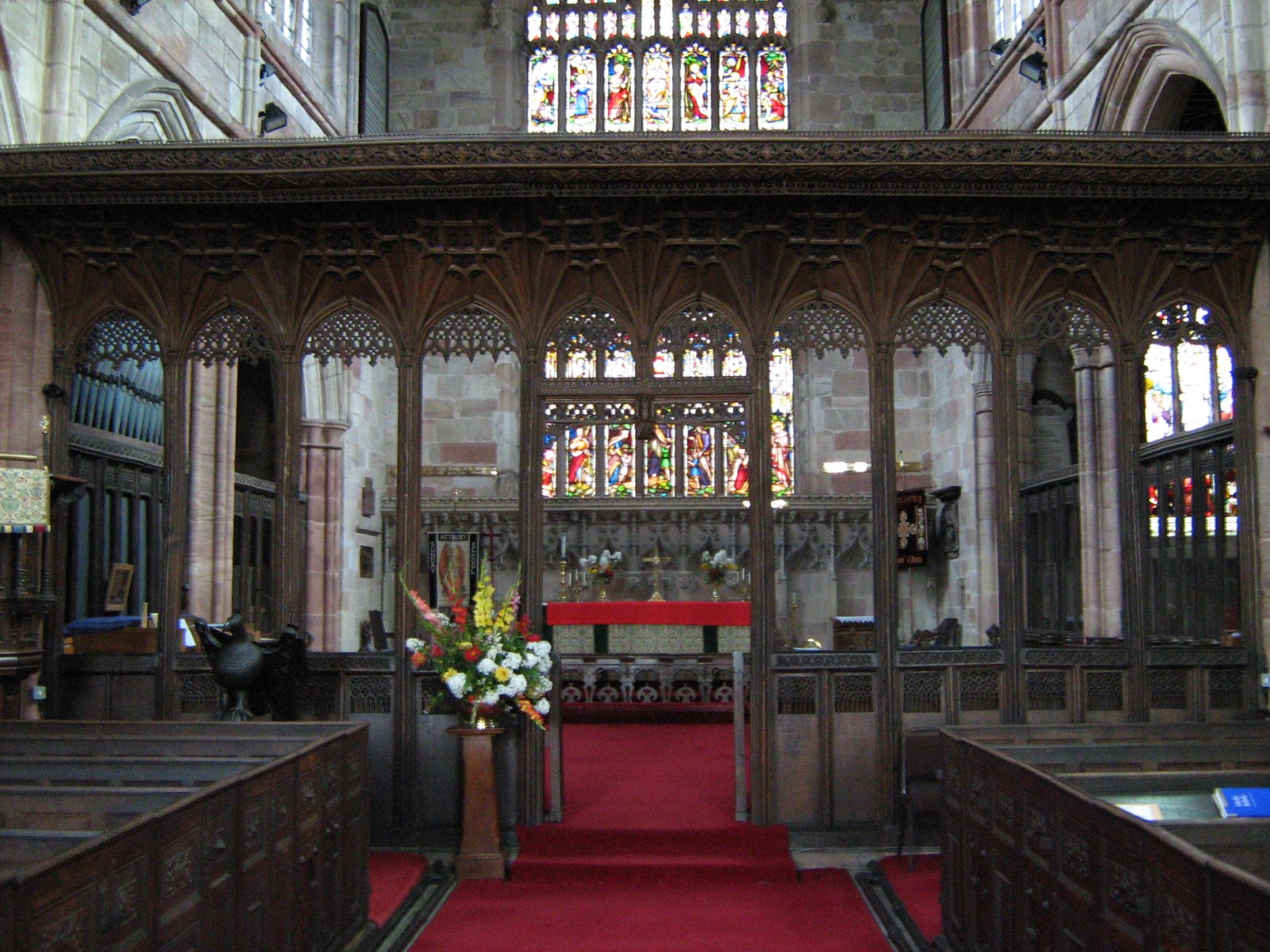
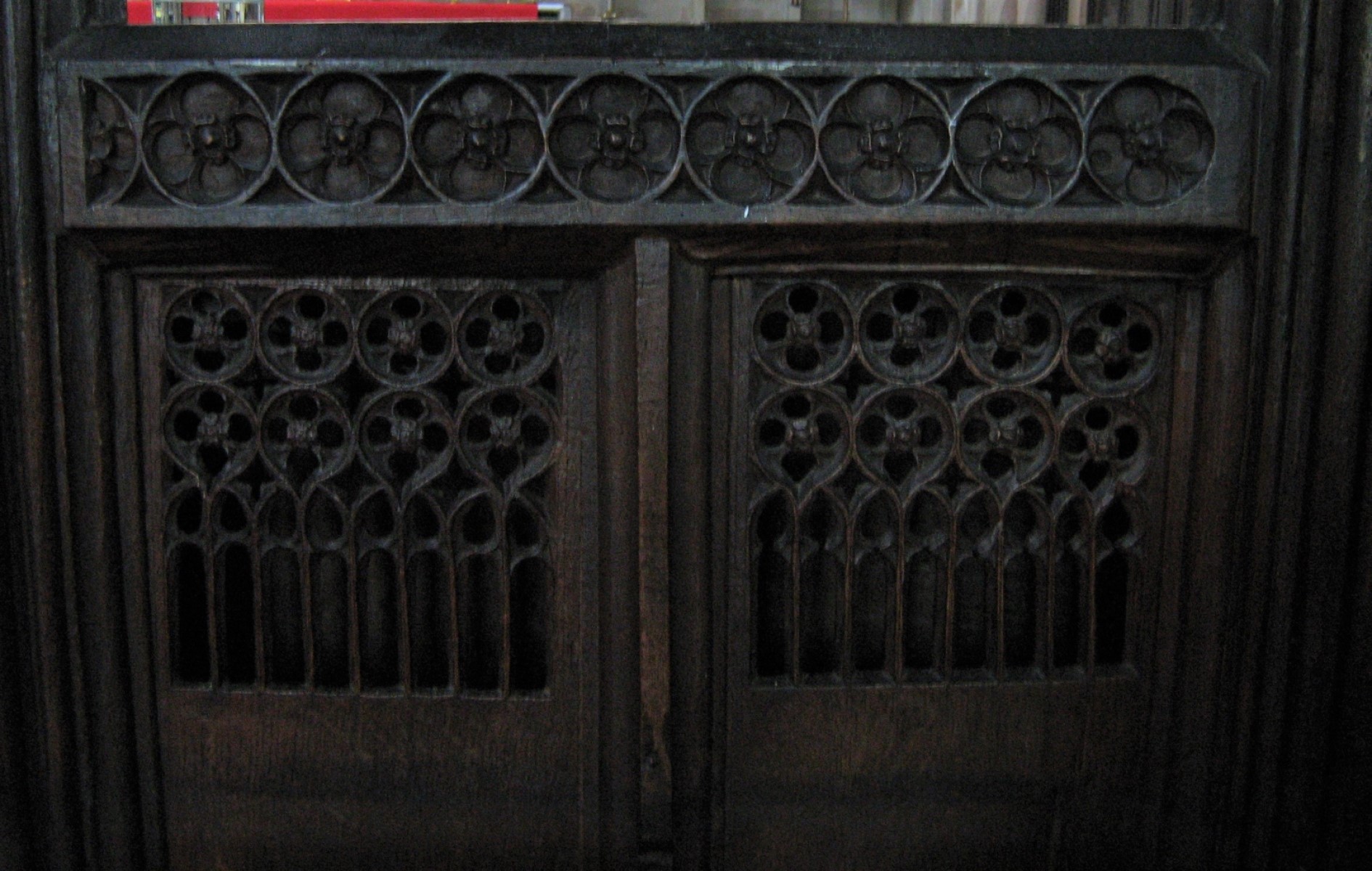
The existing church was originally built in the twelfth century but substantially altered over the next three hundred years. The church building is unusual in that the tower, probably dating from the fourteenth century, is not integrated into the main building, but connected to it by a passage. Much of the woodwork of the interior, including the chancel screen and the parclose screen (separating the aisle from the nave), dates from about 1500, and it is thought that a surviving wall painting of St George dates from about the same time.

The fourteenth-century tomb of Ralph Davenport can be seen in the church, in the churchyard is a medieval canopied tomb, but the figures of a knight and his lady associated with it have been badly weathered.

Sources:

Rev. J. E. G. Cartlidge, Newbold Astbury and its History (Congleton, 1915: reprinted 2004)

J. P. Earwaker, The History of the Church and Parish of St Mary-on-the-Hill Chester (London, 1898), p. 80

Miriam Gill, ‘ “Now help, St George, oure lady knyght … to strengthe our Kyng and England ryght”. Rare scenes of Saint George in a wall painting at Astbury, Cheshire’, Transactions of the Lancashire and Cheshire Antiquarian Society, 91 (1997) pp. 91-102.

Douglas Jones, The Church in Chester 1300-1540 (Chetham Society 3rd series, 7, 1957), p. 176

George Ormerod, The History of the County Palatine and City of Chester (second edition, revised and enlarged by T. Helsby, London, 1882), vol. iii, pp. 21-72

The black and white images are reproduced from volumes 64, 68 and 69 of the Transactions of the Historic Society of Lancashire and Cheshire by kind permission of The Historic Society of Lancashire and Cheshire.

Click to view fullscreen

Subjects: Clothing


Widget not in any sidebars

In the sixteenth century most people owned very few clothes and would often bequeath them specifically in wills.

Gift of clothing as a love token

EDC 5/1580/8 – The defendant claimed that the plaintiff had said her (the plaintiff’s) husband had paid for a new hat and kirtle (a sort of dress) for the defendant