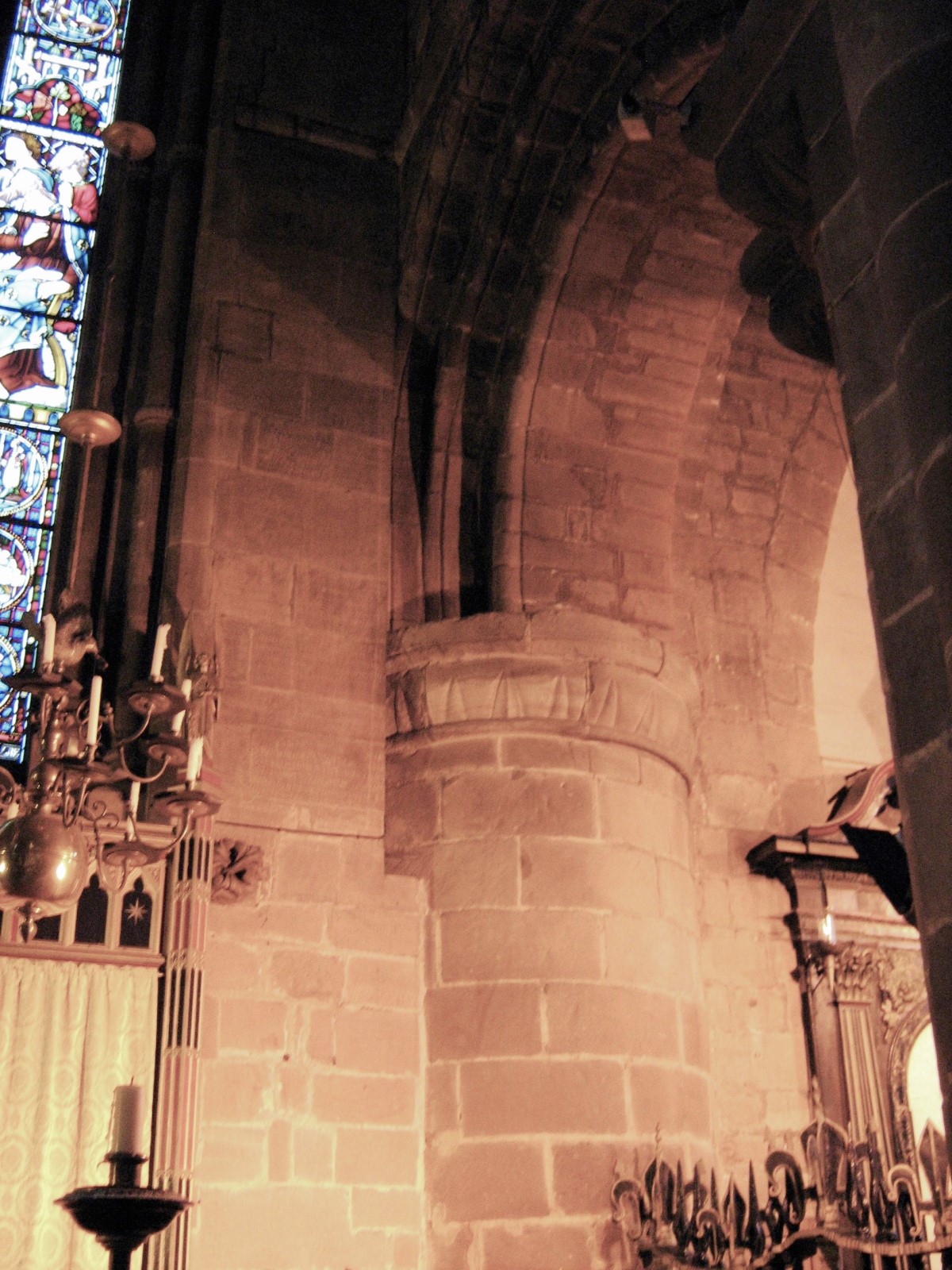
Places: Chester, St John


Widget not in any sidebars

Place Type

Parish

County

Cheshire

Parish

Chester, St John

Deanery

Chester

Causes

EDC 5/10/1 – William Aldersey contra Thomas Wright and Richard Broster
EDC 5/1580/4 – Elizabeth Meycock contra Thomas Davie
EDC 5/1591/2 – Andrew Brednam M.A., vicar of St John’s in Chester contra Henry Aneon, senior

CHESTER, St JOHN

The collegiate church of St John played an important role in the religious and civic life of Chester and was home to a number of chantries plus the guild or fraternity of St Anne, many of which had chapels within the church. It had acquired an important relic, the Rood of Chester, which generated income for the college from the offerings of pilgrims until it was removed in the mid-1530s.

The consistory court of the archdeacon of Chester was held at St John’s until it was removed to the cathedral after the foundation of the new diocese in 1541. In 1547 or 1548 the college was dissolved, its church became a parish church and the advowson passed to the Crown by whom it was granted or sold to a series of lay patrons, including Alexander Cotes who acquired it in 1587 and came into conflict with the parishioners.

After the dissolution the building was too large for the parishioners to maintain, the eastern part fell into decay and in the 1570s the north-west tower collapsed onto the west end of the church which was rebuilt at great cost.

Sources

The volumes of the Victoria County History of Cheshire covering the city of Chester are available online:

https://www.british-history.ac.uk/vch/ches/vol5/pt2/pp125-133

https://www.british-history.ac.uk/vch/ches/vol5/pt2/pp133-156


Click to view fullscreen

Places: Farndon


Widget not in any sidebars

Place Type

Parish

County

Cheshire

Parish

Farndon

Deanery

Chester

Causes

EDC 5/1566/12 – Hugh Dodd, rector of Coddington, contra Richard Allen of Farndon regarding the tithes of Bechin
EDC 5/1587/8 – Katherine Clubb contra John Ledsam

FARNDON

Farndon was a small parish close to the Welsh border on the river Dee. It comprised the townships of Farndon, Barton, Clutton and Crewe, plus a moiety of Churton.

The church building, which may have been constructed in the thirteenth century, was badly damaged by fire during the Civil War, during the struggle to control the river crossing. It was subsequently rebuilt, and the only remaining part of the medieval building is the tower. A window of painted glass, restored in the nineteenth century, commemorates Royalist soldiers of the Civil War. An illustration of the window, shown below, is from a drawing by the Very Rev Hugh Cholmondley, Dean of Chester, contributed to the 1819 edition of Ormerod’s History of the county (between pages 408 and 409 of volume 2).

The church was appropriated to the college of St John in Chester, although the rectory was farmed out at various times. Following the dissolution of the college in 1547 or 1548 the parish was impropriated, and by the nineteenth century it was the property of the family of Grosvenor of Eaton who were responsible for appointing a perpetual curate to serve the parish.

At times parts of the tithes were sold or leased.

Sources

Douglas Jones, The Church in Chester 1300-1540 (Chetham Society 3rd series, 7, 1957), pp. 51, 88.

George Ormerod, The history of the county palatine and city of Chester: compiled from original evidences (London, 1819), vol. ii

George Ormerod, The History of the County Palatine and City of Chester (second edition, revised and enlarged by T. Helsby, London, 1882), vol. ii, pp. 742-745

Click to view fullscreen

Places: Holt


Widget not in any sidebars

Place Type

Chapelry

County

Denbighshire

Parish

Gresford

Deanery

St Asaph

Causes

EDC 5/1587/8 – Katherine Clubb contra John Ledsam

HOLT

Although it was a chapelry of the parish of Gresford, which was in the diocese of St. Asaph, Holt was in the diocese of Chester at this time.

Officials: Pennant, Henry


Widget not in any sidebars

HENRY PENNANT

Notary Public and Deputy Registrar of the diocese

HENRY PENNANT

Notary Public and deputy to Randle Cotgrave, Registrar of the diocese

Qualifications: Notary Public

Career: Deputy Registrar of the diocese from at least 1572, he sometimes acted as promoter in promoted office causes. By the 1580s he had begun to act as a proctor.

Henry Pennant’s signature from EDC 5/1576/43

Notes: He copied some lines of poetry into the last surviving page of one of his account books. These lines formed part of Jasper Heywood’s 1560 translation of Seneca’s play Thyestes.

Sources:

Cheshire Sheaf, 3rd series, xii, pp. 6-7, 12.

People: Yardley, John


Widget not in any sidebars

Surname

Yardley

Forename

John

Sex

Male

Marital Status

Unknown

Occupation Status

Gentleman

Remarks

He is probably John Yardley of Calcott (or Caldecott), one of the gentlemen of Broxton Hundred listed in the visitation of Cheshire in 1580; The visitation of Cheshire in the year 1580 made by Robert Glover, ed. J. Paul Rylands (London, 1882), p. 7. Caldecott is about 3½ miles from Holt, where John Ledsam lived, and about 5 miles from Commonwood where William Ledsam lived.

Causes

EDC 5/1587/8 – one of the addressees of William Ledsam’s letter to the court

All People

Directory – People

People: Ledsam, William


Widget not in any sidebars

Surname

Ledsam

Forename

William

Sex

Male

Marital Status

Unknown

Literacy

Yes - the signature at the bottom appears to be in the same writing as the body of the letter

Remarks

Brother of John Ledsam

Causes

EDC 5/1587/8 – wrote a letter to the court

All People

Directory – People

People: Ledsam, John


Widget not in any sidebars

Surname

Ledsam

Forename

John

Sex

Male

Parish

Holt

Marital Status

At Issue

Occupation Status

Joiner

Remarks

Brother of William Ledsam

Causes

EDC 5/1587/8

All People

Directory – People

People: Clubb, Katherine


Widget not in any sidebars

Surname

Clubb

Forename

Katherine

Sex

Female

Parish

Farndon

Marital Status

At Issue

Causes

EDC 5/1587/8

All People

Directory – People

Places: Churton Heath


Widget not in any sidebars

Place Type

Chapelry

County

Cheshire

Parish

Chester, St Werburgh

Deanery

Chester

Causes

EDC 5/1575/3 – John Vawdrey and Richard Vawdrey contra Ralph Calveley

CHURTON HEATH

Also known as Church in Heath, Churchenheath, or several other variants, the chapel here was also known as Bruera Chapel. Although it was part of the parish of St Werburgh in Chester, it is situated about six miles south of Chester.

Officials: Downham, William


Widget not in any sidebars

WILLIAM DOWNHAM

First Elizabethan bishop of Chester; actively involved in the work of the consistory court during his episcopate.

WILLIAM DOWNHAM (DOWNAM), bishop of Chester, (c. 1511 – 1577)

Qualifications: Bachelor of Arts 1541; Master of Arts 1543; Doctor of Divinity 1566 (Oxford)

CCEd person ID 65611

Career: brother of the College of Bonhommes at Ashridge, then in Buckinghamshire, until its dissolution in 1539, probably consecrated priest while there, he entered Oxford University in 1539 after the dissolution of the college. He was fellow of Magdalen College by 1543; held a number of parishes, mostly in the diocese of Lincoln all of which he had resigned by the time he became bishop of Chester; archdeacon of Brecon 1559,  canon of Westminster 1560 to 1564. He was appointed chaplain to Princess, later Queen, Elizabeth.

He was consecrated bishop of Chester in May 1561 and held the see until his death in 1577, probably in late November

Further notes: Downham was probably born in Herefordshire and is unlikely to have visited the north-west before his appointment as bishop of Chester. His position as one of Princess Elizabeth’s chaplains during the reign of her Catholic sister, Queen Mary, combined with his ordination as a Catholic priest prior to the break with Rome and his perceived religious conservatism have led to accusations that he remained a Catholic. However, the fact of his marriage by 1554, probably during the reign of the Catholic Queen Mary, would argue against this, since acceptance of clerical marriage was an important theological principle to Protestants. Furthermore, while he was bishop of Chester he insisted on conformity with the Elizabethan Prayer Book and seems to have attempted to follow a middle way between the two extremes of Catholicism and Puritanism, thus alienating both groups, but ‘he had an almost impossible task in remote country’ (Knighton) in one of the poorest sees in the country.

He is also often accused of laziness but he was more assiduous than many contemporary bishops in his supervision of his consistory court. When he arrived in Chester he had no experience of diocesan administration, and familiarised himself with the work of the court by attending almost every general session for the first twelve months he was in Chester and he is invariably addressed as ‘judge’ of the court, so clearly regarded its supervision as his own responsibility and duty. He occasionally presided over court hearings and he also took some depositions, seemingly taking a particular interest in matrimonial causes.

He had two sons and one, or possibly two, daughters and was characterised as ‘a milde, courteous & loueinge man, wisheinge well vnto all’ (Rogers).

Sources:

Christopher Haigh, ‘Finance and administration in a new diocese: Chester, 1541-1641’, in R. O’Day and F. Heal, Continuity and change: personnel and administration of the Church of England, 1500-1642 (Leicester, 1976), pp. 145-66

C. S. Knighton, Downham, William (1510/11-1577) bishop of Chester in , Oxford Dictionary of National Biography (online edition) https://doi.org/10.1093/ref:odnb/7979

David Rogers’ History in British Library, Harley 1948, f. 86v

B. Usher, William Cecil and Episcopacy, 1559-1577 (Aldershot, 2003)

K. R. Wark, Elizabethan Recusancy in Cheshire (Chetham Society, 3rd series, 19, 1971)

F. O. White, Lives of the Elizabethan Bishops of the Anglican Church (London, 1898), pp. 167-171

‘Disbrowe-Dyve’, in Alumni Oxonienses 1500-1714, ed. Joseph Foster( Oxford, 1891), British History Online https://www.british-history.ac.uk/alumni-oxon/1500-1714/pp406-439 [accessed 14 January 2025]

‘Canons (to 1660): Tenth prebend’, in Fasti Ecclesiae Anglicanae 1541-1857: Volume 7, Ely, Norwich, Westminster and Worcester Dioceses, ed. Joyce M Horn( London, 1992), British History Online https://www.british-history.ac.uk/fasti-ecclesiae/1541-1847/vol7/pp80-81 [accessed 14 January 2025]

‘House of Bonhommes: The college of Ashridge’, in A History of the County of Buckingham: Volume 1, ed. William Page( London, 1905), British History Online https://www.british-history.ac.uk/vch/bucks/vol1/pp386-390 [accessed 14 January 2025]